
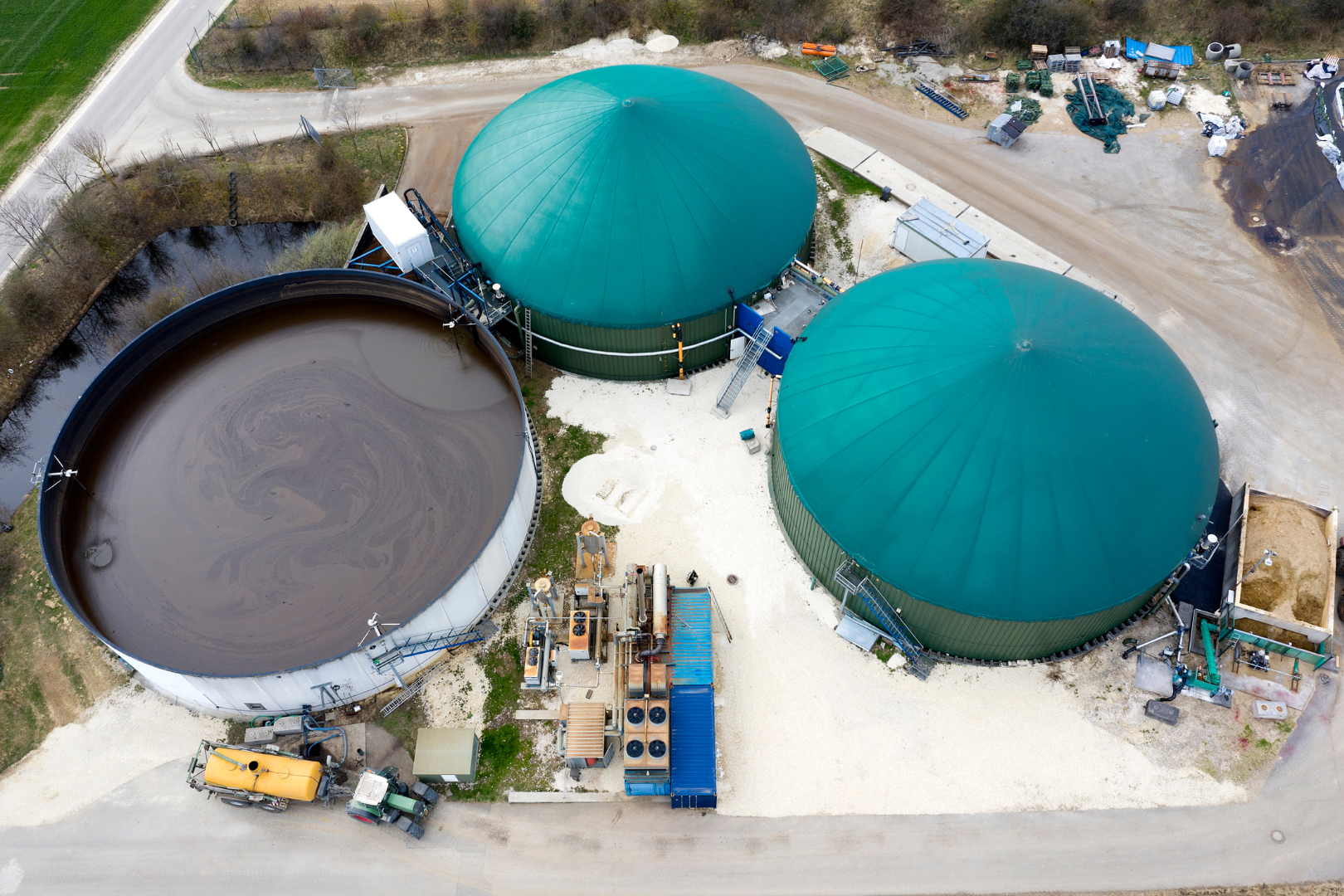
Biogas in WWTPs is the most underused operational opportunity in the Spanish water sector. Most plants with anaerobic digestion digest only primary and secondary sludge, when they could produce considerably more biogas by co-digesting with the organic fraction of municipal solid waste (OFMSW).
Well-managed co-digestion raises biogas production with a small increase in the dewatered sludge to be managed, because OFMSW degrades much more than sludge, and improves the traceability of the digestate as a recoverable by-product.
The operational question is not whether co-digestion works, but how it is designed without compromising effluent quality or the sludge line.
Biogas production in WWTPs is one of the most mature use cases of industrial anaerobic digestion: it has been operated for decades and is a standard part of the design of medium and large plants.
But the sector learning curve has stalled at the first step: digesting only the internal sludge and accepting the biogas generated as a by-product of sludge treatment.
The second step, where the real value lies, is operating anaerobic digestion as a business unit: maximising biogas production through co-digestion, controlling the cost of final dewatered sludge management and monetising the digestate under the applicable regulations.
This article describes what changes between primary and secondary sludge, why co-digestion with OFMSW is the step with the greatest return, what to watch in digestate quality and when thermal pre-treatment starts to pay off economically.
What changes in WWTP biogas compared with agro-industrial biogas
Anaerobic digestion in a WWTP shares the biochemistry with agro-industrial digestion, but operates under very different contractual and regulatory constraints. Three structural differences explain it:
- The primary objective is not the biogas: it is compliance with the effluent discharge to the receiving watercourse. Biogas is a by-product of sludge treatment. Any decision about the digester must guarantee that the sludge line does not destabilise, because the digester return streams (supernatant, dewatering liquor from the digested sludge) go back to the head of the WWTP and affect the discharge.
- The substrate is endogenous and very stable: primary and secondary sludge have a predictable composition and a constant flow, linked to the treated water flow. That makes operational control easier, but it caps the production ceiling: the methane production potential (BMP) of sludge is relatively low (150-350 NmL CH₄/g VS) compared with energy substrates such as silages (290-340) or fats, oils and grease (FOG), which reach 800-1,000.
- Co-digestion is optional and highly profitable: a WWTP with oversized digestion capacity (very common in plants designed before primary treatment optimisation) can accept external substrates for a gate fee, generating two simultaneous revenue streams: the treatment fee for the incoming waste and the additional biogas produced.
WWTP + OFMSW co-digestion: the case with the greatest return
The co-digestion of WWTP sludge with OFMSW (organic fraction of municipal solid waste) is, in economic terms, the biogas use case with the best TCO in the sector.
Three effects accumulate:
- The average BMP of the diet rises: OFMSW has 350-500 NmL CH₄/g VS against 150-350 for sludge.
- The plant absorbs more volume, using idle digester capacity.
- OFMSW is more biodegradable than sludge: it brings a lot of biogas and relatively little dewatered sludge to be managed.
The critical condition for it to work is the stability of the input. The OFMSW received must be pre-treated beforehand (removal of impurities, shredding, homogenisation) and characterised per batch.
If the WWTP receives OFMSW with plastics, glass or metals that have not been separated, the mechanical problems in pumps, heat exchangers and mixers wipe out the economic return.
The operational rule: the WWTP must not become a waste pre-treatment plant, but receive an already conditioned substrate.
And before fixing the OFMSW fraction it is worth validating it in the laboratory. The BMP of the OFMSW tells you how much potential it has, but it is a batch test, under ideal conditions and with a single load. The semi-continuous test feeds a laboratory reactor continuously over several weeks, with the load and retention time of the real digester, and reveals the kinetics, the tolerance to load, the inhibitions and the acclimation time. In a WWTP that is especially valuable, because it makes it possible to anticipate the effect on the return streams to the plant head before touching the plant.
Typical WWTP + OFMSW co-digestion ratio
The OFMSW fraction in the mixture usually sits between 10% and 25% of total VS fed to the digester.
Below 10% the economic effect is marginal. Above 25% the risk of destabilisation increases (propionic acid accumulation, ammonia peaks if the OFMSW has a high protein fraction) and managing the return streams to the plant head becomes more complex.
As a guide, the operational and economic optimum usually sits at 15-20% OFMSW on VS in most medium and large plants.
VS reduction and final sludge disposal
The cost of final dewatered sludge management is one of the highest OPEX items in a medium-sized WWTP, with typical values between EUR 40 and 90 per tonne of wet sludge depending on the destination: agricultural recovery, external composting or landfill.
Every additional percentage point of VS removal in the digester translates into less dewatered sludge produced.
That saving comes from improving the degradation of the sludge itself (temperature, retention time, pre-treatments), not from co-digestion: OFMSW adds biogas, but it also brings its own solids, so total dewatered sludge rises slightly.
In figures: for a plant managing 8,000 t/year of dewatered sludge at EUR 65/t, every 1% less sludge is worth about EUR 5,200 a year in final disposal alone.
Digestate quality and agronomic limitations
The digestate (the digested sludge; after dewatering, its solid fraction is the sludge recovered on land) can be recovered agronomically as an organic amendment, but its agricultural use is governed by Royal Decree 1310/1990, on the use of sewage sludge in agriculture, whose heavy metal limits have referred since 2024 to annex IV of Royal Decree 1051/2022, on sustainable nutrition of agricultural soils. Regulation (EU) 2019/1009 on fertilising products excludes sewage sludge, so this digestate cannot be marketed as an EU fertilising product.
The agronomic quality of the digestate from a co-digesting WWTP depends critically on the quality of the external substrates accepted.
| Parameter | Legal limit or reference | Main risk |
|---|---|---|
| Cd (cadmium) | ≤ 10 mg/kg DM (legal limit) | Uncharacterised industrial substrates |
| Pb (lead) | ≤ 750 mg/kg DM (legal limit) | OFMSW with metallic impurities |
| Hg (mercury) | ≤ 10 mg/kg DM (legal limit) | Poor screening |
| Pathogens (E. coli) | No legal limit for digested sludge (fertilising product reference: < 1,000 per g of product) | Incomplete digestion or absent thermal pre-treatment |
| Salmonella | No legal limit for digested sludge (fertilising product reference: absent in 25 g) | Mesophilic digestion without hygienisation |
| Impurities (plastics) | No legal limit for the sludge (EU fertilising digestate reference: ≤ 3 g/kg DM of glass, metal or plastic > 2 mm) | OFMSW poorly screened at source |
Thermal pre-treatments: when they pay off
Thermal pre-treatments (THP, Thermal Hydrolysis Process, with commercial technologies such as CAMBI, Exelys or BIOTHELYS) subject the sludge to thermal hydrolysis at about 140-165 °C and 6-8 bar before it enters the digester.
The biochemical effect is twofold:
- Solubilisation of the organic matter that is difficult to biodegrade, above all from secondary sludge, rich in biomass with resistant cell walls.
- Hygienisation of the sludge (it comes out practically free of pathogens).
The operational result is an increase in biogas production (manufacturers speak of up to 50%) and a hygienised digestate, although its agricultural use remains subject to the metal limits and application periods of Royal Decree 1310/1990.
THP is usually reserved for large plants, for two reasons: the CAPEX is high (several million euros) and the thermal OPEX requires economies of scale for the extra biogas to offset the energy consumed.
For medium-sized plants the ROI is usually marginal, unless there are additional drivers (a demanding agronomic destination, high final disposal costs). In small plants, THP rarely pays off.
Illustrative case: 150,000 PE WWTP with OFMSW co-digestion
Figures calculated from typical values in the technical literature; they do not correspond to a specific plant.
A 150,000 PE WWTP with two mesophilic digesters (38 °C) and a hydraulic retention time of 22 days. Exclusive digestion of mixed sludge (60% primary, 40% thickened secondary): about 10,500 kg of dry matter a day, with 75% volatile solids. With VS removal of 41%, the plant produces about 2,900 m³ of biogas a day (19 L per PE per day) and about 12,100 t/year of dewatered sludge at 22% dryness.
Intervention: incorporating pre-treated OFMSW
An agreement with a nearby mechanical-biological treatment (MBT) plant to receive pre-treated OFMSW, with removal of impurities and prior shredding.
Gradual increase from 5% to 18% of total VS fed over 16 weeks, with reinforced monitoring of FOS/TAC, individual VFAs (especially propionic acid), total ammonia and supernatant quality. At 18%, the OFMSW brings in about 1,700 kg of VS a day and the retention time falls from 22 to about 21 days.
Result in steady operation
Biogas production: 2,900 → 3,900 m³/day (+35%).
VS removal of the mixture: 41% → 47% (+6 points).
Annual dewatered sludge: 12,100 → 13,200 t (+9%). OFMSW degrades better than sludge, but it adds solids to the digester: the final mass to be managed rises slightly.
Frequently asked questions about biogas in WWTPs
How much biogas does WWTP sludge produce?
The typical BMP of primary sludge sits between 250 and 350 NmL CH₄/g VS; that of thickened secondary sludge, between 150 and 250 NmL CH₄/g VS, lower because of the greater resistance of the cell walls of the biomass.
In industrial operation, the real specific productivity stays below the theoretical BMP, conditioned by the digester HRT and the composition of the mixture; that real percentage is precisely what a semi-continuous test measures, and a BMP does not. Co-digestion with OFMSW can markedly raise the average productivity of the diet.
What type of OFMSW can be co-digested with WWTP sludge?
Suitable OFMSW must be pre-treated beforehand at an MBT or sorting plant: removal of impurities (plastics, glass, metals), shredding to a size < 12 mm and homogenisation.
Receiving untreated OFMSW at the WWTP does not pay off: the mechanical problems in pumps, heat exchangers and mixers wipe out the economic return. The minimum characterisation must include VS, C/N ratio, impurity content and absence of critical pathogens.
How does co-digestion affect the digestate and its agronomic use?
Co-digestion with OFMSW can improve the nutrient content (N, P, K) of the digestate, but it can also worsen its quality if the OFMSW brings in heavy metals or non-separable impurities.
Agricultural use of digested sludge is governed by Royal Decree 1310/1990, with heavy metal limits (Cd, Pb, Hg, among others) that refer to annex IV of Royal Decree 1051/2022; Regulation EU 2019/1009 excludes sewage sludge. Analytical traceability of the digestate is critical: characterisation per batch, not only quarterly.
When does a thermal pre-treatment such as CAMBI or Exelys pay off?
Generally in large plants, because of the high CAPEX required and the need for economies of scale to amortise the thermal OPEX.
In medium-sized plants the ROI is usually marginal, unless there are additional drivers, such as an agronomic destination that requires hygienised sludge or high final sludge disposal costs. In small plants it rarely pays off.
How is OFMSW input validated without risking the sludge line?
With a prior semi-continuous test. In a WWTP the risk is not only the digester: the digester return streams go back to the plant head and can compromise the discharge, so trial and error at plant scale is expensive.
A laboratory reactor fed continuously over several weeks, with the planned OFMSW fraction and the real HRT, shows in advance up to what percentage the system holds, how much ammonia accumulates and how many weeks the consortium needs to acclimate. The BMP does not give that information: it is a batch test that measures the maximum potential under ideal conditions.
Does your WWTP digest only sludge?
You are probably leaving money on the table. Request a Smallops Operational Excellence Diagnosis and we will assess the co-digestion potential without compromising the sludge line or the effluent.
Normative and bibliographic references
Mehariya, S. et al. (2018). Co-digestion of food waste and sewage sludge for methane production: Current status and perspective. Bioresource Technology, 265, 519-531.
Nghiem, L.D., Koch, K., Bolzonella, D. and Drewes, J.E. (2017). Full scale co-digestion of wastewater sludge and food waste: Bottlenecks and possibilities. Renewable and Sustainable Energy Reviews, 72, 354-362.
Royal Decree 1051/2022, of 27 December, establishing rules for sustainable nutrition in agricultural soils.
Royal Decree 1310/1990, of 29 October, regulating the use of sewage sludge in agriculture.
Regulation (EU) 2019/1009 on EU fertilising products.