
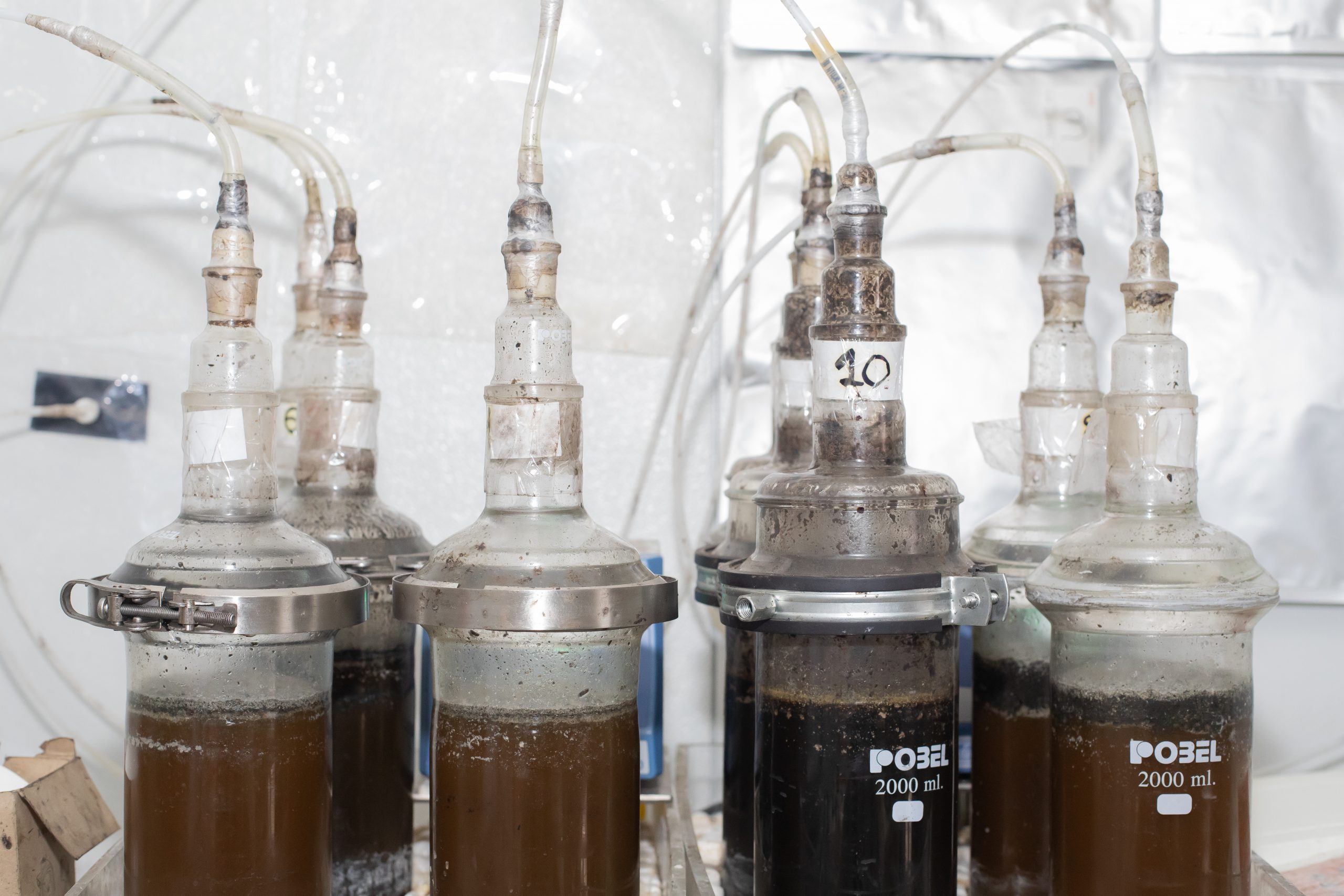
BMP tests that do not comply with the VDI 4630 protocol introduce biases of 20-40% in the results.
The critical points are the inoculum-to-substrate ratio (ISR ≥ 2 on VS), acclimation of the inoculum, the inclusion of triplicates and endogenous blanks, the termination criterion (daily production < 1% of the cumulative value) and kinetic fitting with Gompertz or first-order models.
Applying the standard correctly marks the difference between a usable figure and one that leads to wrong decisions. And even when it is met, the BMP answers how much potential there is, not how it will behave in my digester: that is what the semi-continuous test answers.
Designing a biogas plant, selecting a substrate or validating a process without reliable BMP data means operating with maximum uncertainty.
The problem is not that BMP tests are complex: it is that small protocol errors produce systematic biases that are not visible at first glance.
This article describes, point by point, the criteria set by the VDI 4630 standard for a BMP test to be reproducible, comparable and usable in engineering.
What the VDI 4630 standard requires of a BMP test
The VDI 4630 standard is the European reference for measuring the biogas production potential through batch tests. It sets the minimum requirements for results to be comparable between laboratories and usable in engineering projects:
- Incubation temperature: 35 °C ± 1 °C under mesophilic conditions.
- Gas measurement temperature recorded.
- Volatile solids content of the inoculum and the substrate.
- Inoculum validation using reference substrates.
Without meeting these requirements, the reported BMP is neither comparable with that of other laboratories nor reliable for sizing a plant.
Inoculum-to-substrate ratio (ISR): why ≥ 2 on VS
The inoculum-to-substrate ratio (ISR) expresses the mass relationship between inoculum and substrate, calculated on a volatile solids (VS) basis.
VDI 4630 sets a minimum ISR of 2 on VS to ensure that the microbial biomass is sufficient to degrade the substrate without going into inhibition through overload.
When the ISR is below 2, the substrate exceeds the capacity of the available biomass: volatile fatty acids accumulate, the pH falls and methanogenesis is inhibited. The result is an artificially low BMP.
This is the most frequent error in commercial BMP tests that do not follow the standard. For substrates with a high volatile solids load or a high concentration of potential inhibitors (ammonia, sulphides, short-chain fatty acids, LCFAs), the recommended ISR can reach 4-5.
Acclimation of the inoculum: when it is needed and when it is not
The inoculum for a BMP test usually comes from an anaerobic digester in operation. If that digester works with substrates different from the one to be tested, the biomass may not have the optimal microbial consortia to degrade the new substrate, and the measured BMP will underestimate the real potential.
Acclimation means exposing the inoculum to the substrate for a prior period (typically 2-4 weeks) so that the microbial community adapts.
It is especially advisable when:
- The substrate contains specific inhibitors: high ammonia, LCFAs or phenolic compounds.
- The biochemical composition of the substrate differs substantially from the usual diet of the inoculum.
By contrast, it is not needed when the inoculum already comes from a digester working with similar substrates. Inadequate or absent acclimation can produce negative biases of 15-25% in the final BMP.
Triplicates and endogenous blanks: the control almost nobody does
VDI 4630 requires a minimum of 3 replicates (triplicates) per sample for the result to be statistically representative.
Many commercial reports present results in duplicate or with a single bottle, which makes it impossible to assess the variability of the test and to detect faulty or contaminated bottles. The acceptable coefficient of variation between triplicates in VDI 4630 is below 5% on the cumulative BMP.
Endogenous blanks are bottles containing only inoculum, with no substrate. Their function is to quantify the endogenous activity of the inoculum (the gas production due to degradation of the biomass itself) so that it can be subtracted from the BMP measured in the bottles with substrate.
Omitting the endogenous blank overestimates the real BMP by between 5% and 25%, depending on the activity of the inoculum.
Test termination and kinetic fitting
VDI 4630 sets an objective termination criterion: the test ends when daily gas production is below 1% of the total cumulative volume up to that moment.
This criterion avoids two opposite errors: ending too early, before the whole biodegradable fraction has been degraded, and prolonging the test unnecessarily once the substrate is exhausted.
Kinetic fitting makes it possible to model the cumulative gas production curve to obtain the ultimate BMP (B₀) and the hydrolysis constant (k). The two most used models are:
- Modified Gompertz: describes curves with a lag phase.
- First order: simpler and suitable when there is no significant lag phase.
Kinetic fitting is especially valuable when the termination criterion has not been reached at the end of the test, or when the BMP needs to be extrapolated over longer periods.
Summary of the VDI 4630 standard
| Parameter | VDI 4630 requirement |
|---|---|
| Incubation temperature | 35 °C ± 1 °C (mesophilic) |
| Gas volume measurement | Normal conditions (273 K, 101,325 Pa) |
| Minimum ISR (inoculum/substrate on VS) | ≥ 2 (up to 4-5 with inhibitors) |
| Replicates per sample | Minimum 3 (triplicate) |
| Termination criterion | Daily production < 1% of the cumulative volume |
| Reference substrate | Microcrystalline cellulose validated in the laboratory |
From the BMP to the semi-continuous test: what each one measures
A flawless BMP under VDI 4630 is still a batch test: the substrate is loaded once and the test measures how much methane it can deliver under ideal conditions. It answers one specific question, how much potential this substrate has, and it answers it well.
What it does not answer is how that substrate will behave inside a digester that is fed every day. That is what the semi-continuous test is for: it feeds a laboratory reactor continuously over several weeks, with the load and retention time of the real digester, and reveals the kinetics, the tolerance to load, the inhibitions and the acclimation time. It is the most reliable validation before scaling up.
| BMP test (batch) | Semi-continuous test | |
|---|---|---|
| Feeding | A single initial load | Continuous, over several weeks |
| Question it answers | How much potential the substrate has | How it will behave in my digester |
| What it reveals | Maximum potential (B₀) and kinetics under ideal conditions | Real kinetics, tolerance to load, inhibitions and acclimation time |
| Typical duration | Until the 1% criterion (weeks) | Several weeks of continuous operation |
| When to use it | Screening and comparing substrates | Before scaling up a diet change or an investment |
The two are complementary: the BMP filters, the semi-continuous test validates. Skipping the second is the usual cause of the lab-to-plant gap.
Typical errors in commercial BMP tests
The most frequent errors in commercial BMP tests, which introduce biases of 20-40%, are:
- ISR below 2 (the most common).
- Omission of the endogenous blank.
- Insufficient replicates (in duplicate or with a single bottle).
- Gas measurement temperature not recorded or different from the incubation temperature.
- Inoculum not validated with cellulose or sodium acetate as a reference substrate.
- Arbitrary termination of the test, without following the 1% criterion.
- Gas volume calculation without correcting to normal conditions.
When a laboratory report does not specify the ISR used, the number of replicates, the validity of the inoculum and the termination criterion, the BMP figure cannot be considered reliable for the design of a plant.
Frequently asked questions about BMP tests and the VDI 4630 standard
What is the VDI 4630 standard and why does it matter for BMP tests?
VDI 4630 (Verein Deutscher Ingenieure, 2016 edition) is the German reference standard for determining the biogas production potential (BMP) of organic substrates.
It matters because it is the most detailed and demanding standard available in Europe for this type of test, and because many national regulations and financing conditions for biogas projects reference it explicitly. A non-compliant test can introduce biases of 20-40% that invalidate the plant design or the return-on-investment calculations.
What is the optimal ISR ratio in a BMP test?
The minimum ISR according to VDI 4630 is 2 on a volatile solids (VS) basis. The optimal value in practice, for most conventional agro-industrial substrates, sits between 2 and 3.
For substrates with a high content of potentially inhibitory fractions (high ammonia nitrogen, LCFAs, phenolic compounds) it is advisable to work with an ISR of 4-5, or to run a series of increasing ISRs to identify the optimal range. Too high an ISR can dilute the effect of the substrate and make the BMP difficult to quantify precisely.
How is a BMP test fitted kinetically?
Kinetic fitting means fitting a mathematical model to the cumulative gas or methane production curve over time. The two most common models are the modified Gompertz, which includes a lag phase (λ), a maximum production rate (Rmax) and the ultimate BMP (B₀), and first order, which describes the degradation with a constant k and the ultimate BMP.
The fitting is done by non-linear regression, minimising the mean squared error. It makes it possible to obtain the ultimate BMP even when the 1% termination criterion has not been reached, and it provides information on the kinetics of the process (hydrolysis rate, lag phase) that is useful for digester design.
Is a BMP compliant with VDI 4630 enough to decide on a substrate change?
For screening and comparing substrates, yes. For deciding on a diet change in a running plant, not always: the BMP measures the maximum potential under ideal conditions, with the substrate loaded all at once.
A real digester is fed daily, with a specific load and retention time, and that is where effects appear that batch testing does not see: accumulation of intermediates, progressive inhibitions or a long acclimation time. The semi-continuous test reproduces those conditions over several weeks and is the step that avoids the surprise at plant scale.
How Smallops audits and reproduces BMP tests
Smallops reviews existing BMP reports by applying a checklist based on VDI 4630:
- ISR and number of replicates.
- Endogenous blanks.
- Temperature and inoculum validation.
- Termination criterion and normalisation of the gas volume.
When a report does not meet the requirements, we identify the type of bias to be expected and whether it is correctable or requires repeating the test.
If the client needs new BMP data, Smallops designs the protocol for the test adapted to the specific substrate: appropriate ISR, acclimation where needed, sensitivity series and final kinetic fitting with Gompertz or first order, and a semi-continuous test when the decision depends on the kinetics and not only on the potential.
The result is a BMP figure with known and documented uncertainty, usable for plant design, technology selection and justification to investors or funders.
Would your BMP reports survive an audit?
If you have existing BMP reports or need new tests, request the Smallops BMP Audit: we review ISR, replicates, blanks, termination criterion and kinetic fitting, and tell you what bias each figure carries.
Normative and bibliographic references
VDI 4630 (2016). Fermentation of organic materials. Characterisation of the substrate, sampling, collection of material data, fermentation tests. Verein Deutscher Ingenieure.
Holliger, C. et al. (2016). Towards a standardization of biomethane potential tests. Water Science and Technology, 74 (11), 2515-2522.
Hafner, S.D. et al. (2020). Calculation of biochemical methane potential (BMP) from chemical characteristics and its use for validation of BMP measurement. Water Research, 188, 116515.