
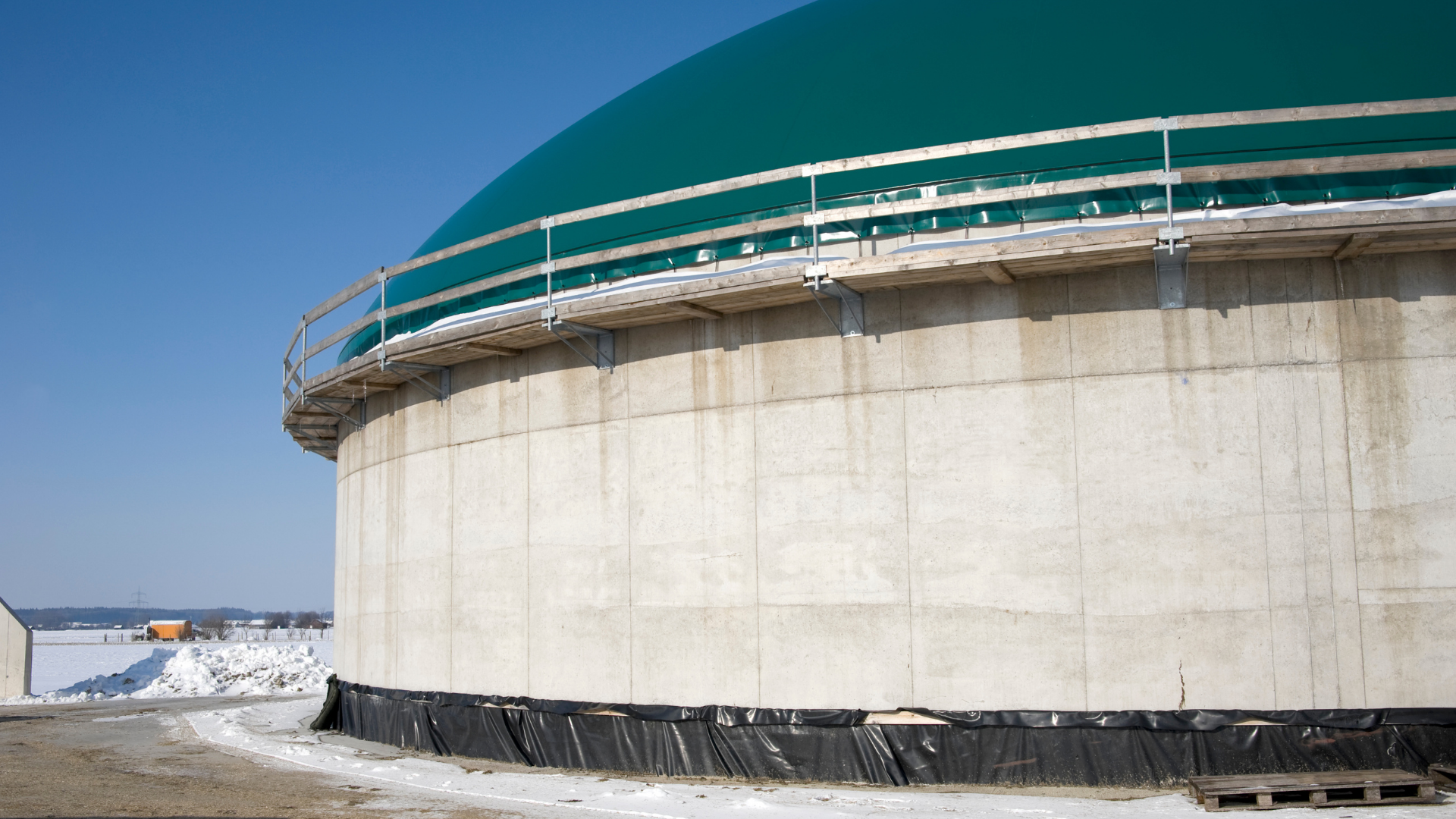
A floating crust is a compact layer of fibre and light material that accumulates on the surface of the digester and stops mixing with the rest of the volume. It is not dirt: it is working volume that disappears.
A consolidated crust can occupy between 10 and 25 % of the reactor volume and take with it between 5 and 15 % of production. It forms with fibrous substrates and insufficient mixing, and it gives plenty of warning before becoming a problem if you know what to look at.
This article explains why crusts form, how to detect them in time, what it costs to remove them and how to stop them from coming back.
The floating crust is one of those problems that do not show up in any analysis and may not even be seen in laboratory experiments, since in some cases it depends on the design of the digester. The FOS/TAC is fine, the VFA are fine, the pH is fine, and yet the plant produces less than a year ago.
The reason is purely physical: part of the digester has stopped being a digester.
This article covers the whole problem: what a crust is, which substrates cause it, what role mixing plays, how it is diagnosed before it consolidates and what options exist once it has formed.
What floating crusts are and why they form
A floating crust is a layer of solid material that separates from the liquid phase and accumulates on the surface of the digester, compacting over time until it forms a rigid structure.
It forms through a combination of three factors:
- Density: lignocellulosic fibres and light materials have a lower density than the digestate and tend to rise.
- Trapped gas: the biogas bubbles generated inside the fibrous matrix are retained and act as floats, pushing the material upwards.
- Lack of drag: if the mixing does not generate enough velocity at the surface, there is no force returning that material to the bulk of the liquid.
At first it is a loose layer that breaks up easily. The problem comes when it consolidates: it loses water, compacts and ends up as a structure that can bear the weight of a person.
Once consolidated, it can no longer be recovered with mixing. It has to be taken out.
Typical crust-forming substrates: straw, silages, fibres
Not all substrates carry the same risk. The ones that generate the most crust share one trait: long, poorly degradable fibre.
| Substrate | Crust risk | Why |
|---|---|---|
| Straw and cereal residues | Very high | Long fibre, low density and slow degradation: it floats before it digests |
| Solid manure with bedding | High | Brings straw or sawdust along with the manure |
| Poorly chopped silages | High | Particle size matters more than the type of crop |
| Plant residues and prunings | High | High lignocellulosic fraction |
| Slurries | Low | Very dilute, little long fibre |
| WWTP sludge | Very low | Practically no floating fibre |
The most underestimated factor is particle size. The same silage chopped to 4 cm and chopped to 1 cm behaves completely differently: the first floats and tangles, the second incorporates.
In agroindustrial co-digestion, crust risk should enter the mix decision just as the C/N ratio or the energy fraction do.
The role of mixing: types and critical velocities
Digester mixing is the variable that decides whether a crust forms or not.
The operational reference is the surface velocity: dragging floating material into the bulk of the liquid takes 0.3-0.5 m/s in the surface zone. Below that range, the light material stays on top no matter how well the bottom is mixing.
This explains a frequent mistake: a plant can have the digester perfectly mixed in volume and still generate crust, because the flow pattern does not touch the surface.
The three usual systems behave differently:
- Submersible propeller mixers: very effective in volume, but if they are poorly oriented they generate no surface drag. Orientation matters as much as power.
- Long-shaft mixers from the roof: the best for the surface, because they work right where the crust forms.
- Gas or liquid recirculation: good for homogenising, weak at breaking a crust that has already started.
The other variable is the regime. Continuous mixing is not always better: with fibrous substrates, an intermittent regime with frequent, short cycles usually works better than a continuous low-intensity one, because it generates velocity peaks capable of dragging the fibre.
The type of reactor also conditions the result, as detailed in types of digesters.
Operational effects: loss of working volume of up to 25 %
The direct effect of a crust is that the volume it occupies stops digesting. And that volume is not small.
In digesters with fibrous substrates and insufficient mixing, a consolidated crust usually occupies between 10 and 25 % of the working volume.
The consequences chain together:
- The real retention time falls. If the digester loses 20 % of its volume and is fed as always, the effective HRT drops by that same proportion: the substrate spends less time inside and leaves without fully digesting.
- The real load rises. The OLR is calculated on the nominal volume, but the substrate enters a smaller volume. A 20 % crust turns a nominal OLR of 3.0 kg VS/m³·day into a real OLR of 3.75.
- Mixing gets worse. The crust acts as a lid and modifies the flow pattern of the rest of the reactor.
- It favours foaming. Crust and foam share causes and feed each other.
The measurable result is a productivity loss of 5 to 15 % when the crust reaches 20 % of the volume.
And it is a particularly treacherous loss, because the plant can be stable, with the sentinel variables in the green, and still be performing below its capacity.
Diagnosis: how to detect crusts before they become a problem
A crust is detected early or detected expensively. A monthly inspection is the minimum reasonable frequency in plants with fibrous substrate.
Signs that point to a crust in formation:
- Slow fall in specific productivity with no change in FOS/TAC or VFA. It is the characteristic signature: a physical problem does not move the biological indicators.
- Rising mixer consumption or thermal trips: the motor is working against a denser mass.
- Temperature differences between probes at different heights: if the upper part is colder, there is a layer that is not mixing.
- A drop in the apparent liquid level without any change in feeding.
- Recurring foaming with no clear biological cause.
The direct check is done through the manhole or the roof ports, with a graduated pole: it is inserted, the resistance is found and the thickness of the layer is measured. It is a rudimentary method, but it is the one that works.
The operational rule: note the thickness every month and watch the trend. A 10 cm crust growing 2 cm per month is a problem with a date; a 10 cm crust stable for a year is not.
Removing consolidated crusts: options and costs
Once the crust is consolidated, more mixing does not undo it: it only makes the mixer work against a wall.
The options, from lowest to highest cost:
- Hydraulic breaking: recirculation of pressurised digestate directed at the surface. It works with young, poorly compacted crusts. It is the only one that does not require a shutdown.
- Mechanical breaking from the roof: with a specific tool through the ports. Slow work, but without emptying the digester.
- Partial emptying and extraction: the level is lowered and the crust is removed through the manhole. It requires a shutdown and confined-atmosphere measures.
- Complete emptying and cleaning: the last option. It involves a long shutdown, loss of the inoculum and a start-up of weeks.
The average cost of a mechanical removal is between €3,000 and €12,000 depending on the size of the plant and the degree of consolidation.
It is worth putting that figure in context: a 500 kWe plant losing 10 % of production to crust is failing to earn well over €12,000 a year. Removal almost always pays for itself in months.
What does not pay for itself is repeating it every year because the cause has not been corrected.
Prevention: mix design and mixing regime
Prevention is cheaper than any removal, and it is played on two fronts.
In the mix
- Control the particle size: chopping below 2 cm in fibrous substrates. It is the most effective measure and the cheapest.
- Limit the fibrous fraction when the mixing system does not provide enough surface drag.
- Spread the feeding throughout the day instead of concentrating it: massive inflows of fibre favour layer formation.
In the mixing
- Verify the surface velocity, not just the installed power. It is the figure that decides.
- Check the orientation of the submersible mixers: a change of angle can solve the problem without spending a euro.
- Adjust the regime to frequent, short cycles instead of continuous low intensity.
- Inspect monthly and record the thickness.
Most plants with recurring crust do not have an equipment problem: they have an adjustment problem. The equipment was sized for the original diet, and the substrate being fed has changed.
Key quantified data
| Concept | Value |
|---|---|
| Typical loss of working volume to crusts | 10-25 % |
| Minimum effective mixing velocity at the surface | 0.3-0.5 m/s |
| Associated productivity reduction | 5-15 % with a crust of 20 % of the volume |
| Average cost of mechanical removal | €3,000-12,000 depending on plant size |
| Recommended inspection frequency | Monthly |
| Recommended particle size in fibrous substrates | Below 2 cm |
Frequently asked questions about floating crusts
What are floating crusts in a biogas digester?
They are layers of solid material, mostly lignocellulosic fibre, that separate from the liquid and accumulate on the surface of the digester. The biogas generated inside that matrix gets trapped and acts as a float, pushing the material upwards.
Over time the layer loses water and compacts until it forms a rigid structure that no longer breaks with mixing. The volume it occupies stops digesting: a consolidated crust takes between 10 and 25 % of the working volume of the reactor.
How are consolidated crusts removed?
There are four routes, from lowest to highest cost: hydraulic breaking with recirculation of pressurised digestate (it only works on young crusts, but requires no shutdown), mechanical breaking from the roof ports, partial emptying with extraction through the manhole, and complete emptying with cleaning.
A mechanical removal costs between €3,000 and €12,000 depending on the size of the plant. Complete emptying is the last option, because it involves a long shutdown, loss of the inoculum and a start-up of several weeks.
What mixing is needed to prevent crusts?
The reference is the velocity in the surface zone: it takes between 0.3 and 0.5 m/s to drag the floating material into the bulk of the liquid. Below that range the crust forms even if the rest of the digester is well mixed.
The orientation of the mixers matters as much as their power, and with fibrous substrates a regime of frequent, short cycles usually works better than continuous low intensity, because it generates velocity peaks capable of dragging the fibre.
How much biogas is lost to floating crusts?
A crust occupying 20 % of the volume translates into a productivity loss of 5 to 15 %. The mechanism is twofold: the real retention time falls and the effective organic load rises, because the same substrate enters a smaller volume.
What is characteristic about this loss is that it does not alter the biological variables: the FOS/TAC and the VFA can be perfect while the plant performs below its capacity. That is why it is a problem that drags on for years without being diagnosed.
Smallops and the physical problems of the digester
Not all production losses are biological. When the analyses come back fine and the plant keeps underperforming, the problem is usually in the physics of the reactor: crusts, sediments, hydraulic short-circuits or poorly adjusted mixing.
At Smallops we quantify the real working volume of your digester and review the mixing regime against your current diet with an Operational Excellence Diagnosis.
Is your plant producing less while the analyses come back fine?
Request a Smallops Operational Excellence Diagnosis: we measure how much working volume you really have left, review the mixing against your diet and tell you whether the loss is biological or physical.
References and standards
Lindorfer, H. & Demmig, C. (2016). Foam formation and crust formation in biogas plants. Bioresource Technology, 209, 360-367.
Wu, B. (2010). CFD simulation of mixing in egg-shaped anaerobic digesters. Water Research, 44 (5), 1507-1519.
Karim, K. et al. (2005). Anaerobic digestion of animal waste: effect of mixing. Bioresource Technology, 96 (14), 1607-1612.
Drosg, B. (2013). Process monitoring in biogas plants. IEA Bioenergy Task 37.