
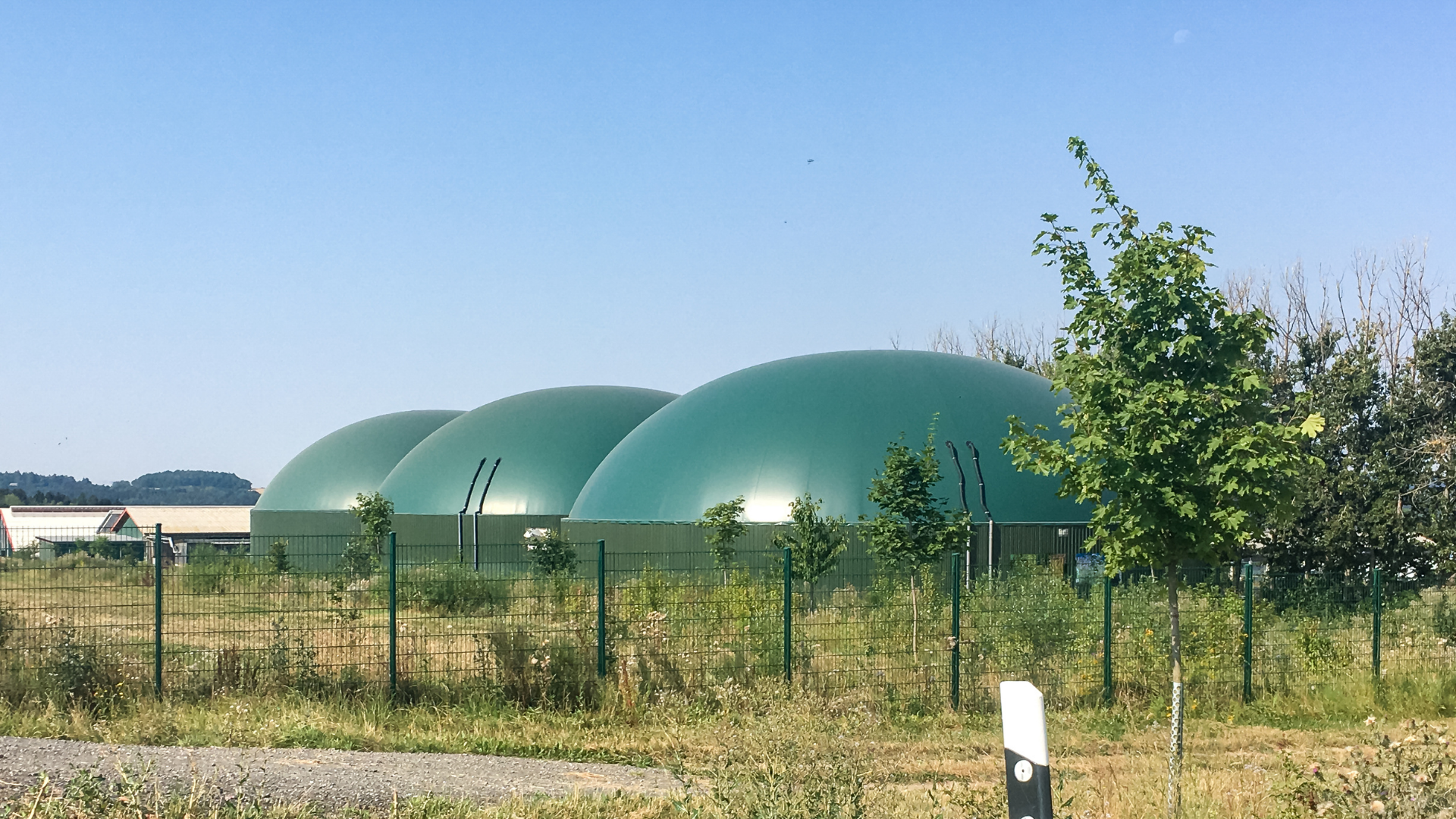
Anaerobic co-digestion means digesting two or more substrates at once in the same reactor instead of just one. Well designed, it balances the digester diet: one substrate provides what the other lacks (carbon, nitrogen, moisture, micronutrients), which stabilises the process and raises methane production by 15-30% against single-substrate operation.
The key lies in the C/N ratio (optimum 20-30) and in respecting the fraction and the rate of incorporation of the most energetic co-substrates.
This article explains what it is, why it works, how a mixture is designed and the errors that ruin it.
Anaerobic co-digestion is, today, the most common way of operating a biogas plant. Almost none runs on a single substrate: they combine several to obtain more methane and more stability.
The idea is simple but powerful: mix substrates that complement each other. Slurry, very dilute and rich in nitrogen, gains a great deal if an energetic, carbon-rich co-substrate such as a silage or a fat is added.
This is the what is of co-digestion: fundamentals, the role of the C/N ratio, its real advantages, the typical errors and how to design a mixture step by step. It builds on the basis of what anaerobic digestion is.
Definition of anaerobic co-digestion
Anaerobic co-digestion is the simultaneous digestion of two or more substrates in the same reactor. It is the opposite of single-substrate operation (one single material), which was the classic model of the first livestock plants.
The objective is not just to put in more material: it is to build a balanced diet for the microbial consortium, in the same way that an animal diet combines ingredients.
A base substrate (slurry, sludge) provides volume and nutrients; a co-substrate provides energy density.
Why co-digestion works: complementarity between substrates
The anaerobic consortium needs a balance of nutrients, moisture and load. Almost no substrate provides it alone. Co-digestion works because each material compensates for what the other lacks:
- Nutrient balance: slurry provides nitrogen and micronutrients; silage or fat provides carbon and energy.
- Mutual dilution: the wet substrate dilutes the concentrated one, avoiding inhibitions.
- Buffering: the alkalinity of one substrate cushions the acidity generated by another.
- Supply of trace micronutrients (Ni, Co, Fe) that the archaea need and that a poor single substrate does not provide.
The result is a more stable process and an increase in specific productivity of between 15% and 30% against digesting each substrate separately.
The C/N ratio and its role in mixture design
The main parameter in mixture design is the carbon/nitrogen (C/N) ratio. It measures the balance between energy (carbon) and available nitrogen.
The optimal range is between 20 and 30:
- Below (excess nitrogen): risk of ammonia inhibition.
- Above (excess carbon): there is not enough nitrogen for the microorganisms to grow and digestion slows down.
For example: slurry has a low C/N (≈ 5-10, plenty of nitrogen) and maize silage has a high one (≈ 30-40). Mixing them brings the whole closer to the ideal range, as detailed in the post on the C/N ratio.
Dilutions, synergies and antagonistic effects
Not every mixture adds up. Co-digestion has three types of effect:
- Synergies: the mixture produces more methane than the sum of the substrates separately, through nutrient balance and buffering.
- Dilutions: one substrate lowers the concentration of an inhibitor present in another (ammonia, salts, fats).
- Antagonisms: sometimes the mixture makes things worse, through an excess of a problematic co-substrate, and generates inhibitions such as LCFA inhibition with fats or free ammonia with protein-rich substrates.
That is why a mixture is not improvised: it is designed with analytical characterisation and introduced in a controlled way.
Operational advantages over single-substrate digestion
Against digesting a single material, well-executed co-digestion delivers:
- More methane per unit of digester volume (a typical improvement of 15-30%).
- More stability: the balanced diet cushions imbalances.
- Better economics: it allows local waste streams (agro-industrial by-products) to be valorised and costs to be shared.
- Flexibility: the mixture can be adjusted according to seasonal availability.
The case of agro-industrial co-digestion shows these advantages with real substrates.
Typical errors in co-digestion and how to avoid them
Most co-digestion problems do not come from the concept, but from the execution:
- Raising the co-substrate all at once: adding too much fat or glycerine in one go inhibits the digester. It is incorporated gradually.
- Not characterising the substrates: designing the mixture by eye, without analysis of C/N, solids and nutrients.
- Ignoring the acclimation time: after changing the mixture, the consortium takes 4-8 weeks to adapt. That time cannot be guessed: it is one of the figures a semi-continuous test returns.
- Exceeding the energetic fraction: going above 25-40% of VS of a highly energetic co-substrate sharply raises the risk of acidification.
Designing a co-digestion mixture step by step
A correct design follows a clear sequence:
- Characterise each substrate: total and volatile solids, C/N, BMP, nutrients and potential inhibitors.
- Define the objective: maximum production, maximum stability or valorising a specific waste stream.
- Calculate the mixture: adjust proportions for a C/N of 20-30 and an energetic fraction below 25-40% of VS.
- Introduce it gradually: raise the co-substrate little by little, watching FOS/TAC, propionic acid and methane production.
- Acclimate and adjust: give the consortium 4-8 weeks and readjust according to the response.
Between step 3 and step 4 there is room for a test that saves a lot of trouble. The BMP from step 1 is a batch test that measures the maximum potential under ideal conditions: it is useful for choosing co-substrates, not for knowing how much the digester can take. The semi-continuous test feeds a laboratory reactor continuously over several weeks, with the calculated mixture and the real retention time, and reveals the kinetics, the tolerance to load, the inhibitions and the acclimation time. In other words: it validates the mixture before trying it out on the whole plant.
| Co-substrate | Typical BMP (NmL CH₄/g VS) | Role in the mixture |
|---|---|---|
| Maize silage | 290-340 | Carbon-rich energy co-substrate |
| FOG / fats | 600-900 | Maximum energy density (with care) |
| Glycerine | 800-1,000 | Concentrated and cheap energy |
Frequently asked questions about anaerobic co-digestion
What is anaerobic co-digestion?
It is the simultaneous digestion of two or more substrates in the same reactor, instead of just one. The objective is to build a balanced diet for the microorganisms: one substrate provides what the other lacks (carbon, nitrogen, moisture or micronutrients).
Well designed, it produces more methane and is more stable than digesting each material separately.
What is the optimal C/N ratio in co-digestion?
The optimal range of the carbon/nitrogen (C/N) ratio is between 20 and 30. Below that there is excess nitrogen and a risk of ammonia inhibition; above it there is not enough nitrogen and digestion slows down.
Mixing a substrate with a low C/N (slurries, sludges) with another with a high C/N (silages, plant residues) brings the whole closer to that ideal range.
Which co-substrates are the most efficient?
The most energetic per kilo are fats and oils (FOG, 600-900 NmL CH₄/g VS) and glycerine (800-1,000), followed by silages (maize, 290-340).
But efficient is not only about BMP: the most energetic ones are also the most delicate (risk of LCFA inhibition) and have to be dosed with care, below 25-40% of the volatile solids.
Why does co-digestion produce more biogas than a single substrate?
For two reasons. First, it adds a co-substrate of high energy density that a dilute substrate does not provide.
Second, and more importantly, it balances the diet: it corrects the C/N, provides trace micronutrients and buffers the pH, so the consortium works under better conditions. That synergy makes the mixture yield more than the sum of the substrates separately, typically 15-30% more.
How is a co-digestion mixture validated before taking it to the plant?
With a semi-continuous test. The characterisation and BMP of each substrate make it possible to calculate the mixture on paper, but the BMP is a batch test: it measures potential, not coexistence. The synergies and antagonisms of a mixture appear when it is fed day after day.
A laboratory reactor fed continuously over several weeks with the proposed mixture shows whether the calculated C/N translates into real stability, at what fraction of energetic co-substrate propionic acid starts to rise and how many weeks the consortium needs to acclimate. With that, the gradual entry at plant scale stops being a trial and becomes an execution.
Smallops and co-digestion design
A well-designed co-digestion mixture is money; an improvised one is a risk.
At Smallops we calculate the optimal diet for your plant and the incorporation ramp with an Operational Excellence Diagnosis.
Are you making the most of your co-digestion?
Request a Smallops Operational Excellence Diagnosis: we characterise your substrates, calculate the optimal mixture and design the incorporation ramp without slowing the digester down.
Normative and bibliographic references
Mata-Alvarez, J. et al. (2014). A critical review on anaerobic co-digestion: achievements between 2010 and 2013. Renewable and Sustainable Energy Reviews, 36, 412-427. → doi.org/10.1016/j.rser.2014.04.039
Hagos, K. et al. (2017). Anaerobic co-digestion process for biogas production: progress, challenges and perspectives. Renewable and Sustainable Energy Reviews, 76, 1485-1496. → doi.org/10.1016/j.rser.2016.11.184
Khalid, A. et al. (2011). The anaerobic digestion of solid organic waste. Waste Management, 31 (8), 1737-1744. → doi.org/10.1016/j.wasman.2011.03.021
Esposito, G. et al. (2012). Anaerobic co-digestion of organic wastes. Reviews in Environmental Science and Bio/Technology, 11, 325-341. → doi.org/10.1007/s11157-012-9277-8