
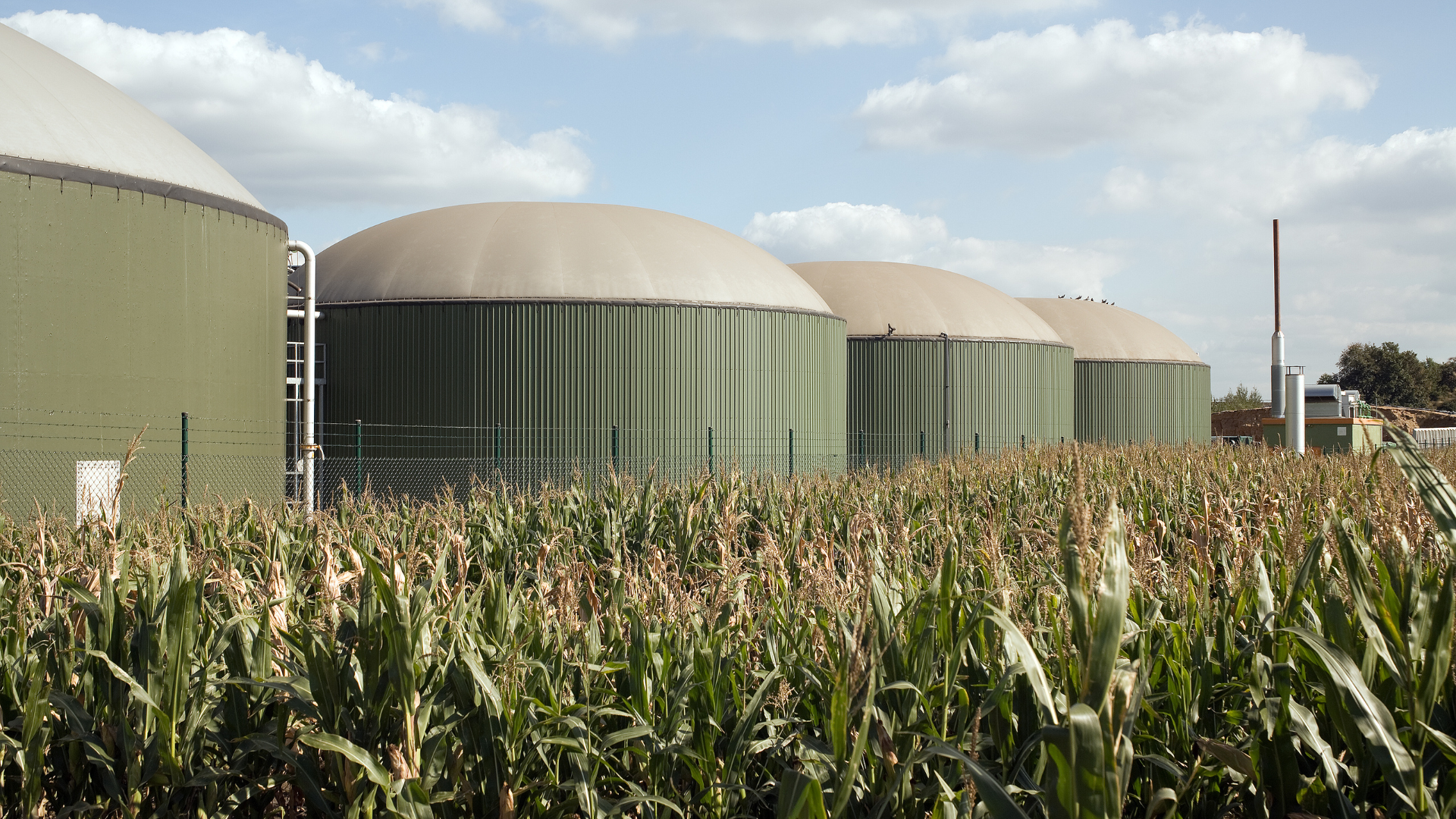
Anaerobic digestion is a biological process in which a consortium of microorganisms breaks down organic matter in the absence of oxygen and generates two valuable products: biogas (a methane-rich mixture) and digestate (an organic fertiliser).
It happens in four linked phases (hydrolysis, acidogenesis, acetogenesis and methanogenesis) and needs controlled conditions of temperature, pH and nutrients. It is the reference technology for treating organic waste and turning it into renewable energy.
This article explains what it is, how it works step by step, which microorganisms are involved, what conditions it needs and what it is used for in industry.
Anaerobic digestion is one of the oldest biological processes on the planet and, at the same time, one of the most relevant technologies in the circular economy. It is the mechanism by which organic matter breaks down without oxygen and turns into biogas and digestate.
It occurs naturally in marshes, sediments and in the digestive tract of ruminants. Biogas engineering does no more than reproduce and control that process inside a closed reactor (the digester) to maximise methane production.
This is the reference guide: what it is exactly, the four biochemical phases that make it up, the microorganisms involved, the conditions it needs and its industrial applications.
Technical definition of anaerobic digestion
Anaerobic digestion is the biological degradation of organic matter in the absence of oxygen, carried out by a consortium of microorganisms working in a chain. The result is two products: biogas (energy) and digestate (fertiliser).
The word anaerobic is the key: the process only works without oxygen. Oxygen inhibits the methanogenic archaea, the microorganisms responsible for producing methane. That is why the digester is a sealed, airtight vessel.
Unlike aerobic decomposition (with oxygen), which releases the energy of the organic matter as heat and CO₂, anaerobic digestion preserves most of that energy in the methane, which can be used as a fuel.
The four biochemical phases of anaerobic digestion
Anaerobic digestion is not a single reaction, but a chain of four simultaneous phases inside the digester, each handled by a different group of microorganisms. If one phase fails, the following ones suffer. Each stage is detailed in the post on the phases of digestion.
| Phase | What happens | Main product |
|---|---|---|
| 1 · Hydrolysis | Large molecules (proteins, fats, carbohydrates) break down into simpler, soluble ones (amino acids, fatty acids, sugars). It is the slowest phase with fibrous substrates. | Soluble monomers |
| 2 · Acidogenesis | The simple molecules ferment. It is the fastest phase; an excess without balance acidifies the digester. | Volatile fatty acids (VFAs), H₂, CO₂ |
| 3 · Acetogenesis | The VFAs are transformed into acetic acid. It depends on a syntrophic relationship: it only works if the archaea remove the hydrogen. | Acetic acid, H₂, CO₂ |
| 4 · Methanogenesis | The archaea produce methane from acetic acid or from H₂ + CO₂. It is the phase that creates the value and the most sensitive one. | Methane (CH₄) |
Methanogenesis is the bottleneck of the process: the archaea are slow and vulnerable to changes in pH, temperature and inhibitors. When something fails in a digester, it is almost always this phase that suffers first.
Microorganisms involved
Anaerobic digestion is teamwork between four microbial groups that depend on one another:
- Hydrolytic bacteria: they break polymers into monomers with extracellular enzymes.
- Acidogenic bacteria: they ferment the monomers into VFAs, alcohols and hydrogen. They are the fastest and most robust.
- Acetogenic bacteria: they convert VFAs into acetic acid, H₂ and CO₂, in syntrophy with the archaea.
- Methanogenic archaea: they produce the methane. They are the slowest (doubling time of 3 to 7 days) and the most sensitive. They set the pace of the whole process.
That mismatch in speeds (fast acidogens, slow methanogens) is the cause of most operational imbalances.
If feeding is too fast, acids accumulate before the archaea can consume them.
Operating conditions the process needs
For the consortium to work, the digester maintains a controlled environment. Four variables are critical:
| Condition | Optimal range | Why it matters |
|---|---|---|
| Temperature | Mesophilic 35-40 °C / Thermophilic 50-57 °C | Determines the speed and the stability of the process |
| pH | 6.8-7.4 | Methanogens only work in the neutral range; below 6.5 they are inhibited |
| Oxygen | Absent | Oxygen is toxic to methanogenic archaea |
| Trace nutrients | Ni, Co, Fe, Mo (small doses) | Cofactors of the methanogenic enzymes |
There are two usual temperature regimes: mesophilic (35-40 °C), more stable and robust, and thermophilic (50-57 °C), faster and with greater pathogen destruction, but more sensitive. The choice between mesophilic and thermophilic depends on the substrate and on the objective of the plant.
Products: biogas and digestate
The process generates two products, both with economic value.
Biogas
A gaseous mixture composed mainly of methane (50-65%) and CO₂ (35-45%), with traces of H₂S (200-3,000 ppmv), water vapour and other compounds.
Its energy content is 5-7 kWh/Nm³ depending on the methane percentage. It is used to generate electricity and heat, or upgraded to biomethane for injection into the grid. It is detailed in the post on biogas composition.
Digestate
The liquid or semi-solid residue left after digestion. It preserves the nitrogen, phosphorus and potassium of the substrate in forms that are more assimilable by plants, so it is recovered as an organic fertiliser.
Managing the digestate well closes the circular economy loop.
Industrial applications
Anaerobic digestion solves two problems at once: it treats waste and produces renewable energy. Its main applications are:
- Waste treatment: livestock slurry and manure, sewage sludge (WWTP), the organic fraction of municipal waste (OFMSW) and agro-industrial by-products.
- Energy production: electricity and heat through cogeneration, or biomethane for the natural gas grid and for transport.
- Agronomic recovery: the digestate replaces mineral fertilisers and reduces emissions.
A single plant can combine several substrates (co-digestion) to balance the diet and maximise production. The choice of digester type depends on the substrate, the scale and the objective.
Differences from other treatment technologies
Compared with other ways of managing organic matter, anaerobic digestion has one key advantage: it recovers energy instead of spending it.
| Technology | Does it need oxygen? | Does it recover energy? | Product |
|---|---|---|---|
| Anaerobic digestion | No | Yes (biogas) | Energy + fertiliser |
| Composting (aerobic) | Yes | No (it spends energy) | Compost |
| Incineration | Yes | Partial (heat) | Ash |
| Landfill | No (uncontrolled anaerobic) | No (it emits methane without capturing it) | Leachate and emissions |
Composting is aerobic and releases the energy as heat; incineration destroys the matter and emits CO₂; landfill generates methane without control, a potent greenhouse gas.
Anaerobic digestion is the only one that captures that methane and turns it into usable energy.
Frequently asked questions about anaerobic digestion
What exactly is anaerobic digestion?
It is a biological process in which a consortium of microorganisms breaks down organic matter in the absence of oxygen. The result is two products: biogas (a methane-rich mixture used as renewable energy) and digestate (an organic fertiliser).
It occurs naturally in marshes and ruminants, and engineering reproduces it under controlled conditions inside a digester.
How does anaerobic digestion differ from aerobic digestion?
The difference is oxygen. Aerobic digestion (such as composting) happens with oxygen and releases the energy of the organic matter as heat and CO₂.
Anaerobic digestion happens without oxygen and preserves most of that energy as methane, usable as a fuel. It also generates far less sludge and allows energy to be recovered rather than consumed.
Which wastes can be treated by anaerobic digestion?
Almost any biodegradable organic waste: livestock slurry and manure, sewage sludge, the organic fraction of municipal waste (OFMSW), food industry residues, glycerines, fats and oils.
Highly lignocellulosic materials (wood, straw) digest poorly without pre-treatment, because the hydrolysis phase is very slow.
How much biogas does a kilo of organic waste produce?
It depends on the substrate. The biochemical methane potential (BMP) of common wastes is between 200 and 500 NmL of CH₄ per gram of volatile solids. Fatty substrates (FOG, oils) produce far more (up to 1,000 NmL CH₄/g VS) and very fibrous ones considerably less.
As a reference, a kilo of easily biodegradable volatile solids can give in the order of 0.3-0.5 m³ of methane. Note: that BMP is a theoretical ceiling measured in batch mode; in a real digester you obtain between 60% and 80% of that figure.
Does the BMP tell you how much methane a substrate will give in my plant?
Not exactly: it tells you how much it can give. The BMP is a batch test that measures the maximum potential under ideal conditions, with a single load and excess inoculum. It is perfect for comparing substrates with each other.
To know how it will behave in a digester that is fed every day you need a semi-continuous test: a laboratory reactor is fed continuously over several weeks, with the real load and retention time, and that shows the kinetics, the tolerance to load, the inhibitions and the acclimation time. It is the most reliable validation before scaling up.
Smallops and anaerobic digestion
Understanding anaerobic digestion is the first step; operating it efficiently is another matter.
At Smallops we turn these fundamentals into real performance: an Operational Excellence Diagnosis measures what is limiting your digester and how to unblock it.
Want to get more out of your digester?
Request a Smallops Operational Excellence Diagnosis: we characterise your process across 14 variables and tell you where the bottleneck is and how to resolve it.
Normative and bibliographic references
Angelidaki, I. & Sanders, W. (2004). Assessment of the anaerobic biodegradability of macropollutants. Reviews in Environmental Science and Bio/Technology, 3, 117-129. → doi.org/10.1007/s11157-004-2502-3
Appels, L. et al. (2008). Principles and potential of the anaerobic digestion of waste-activated sludge. Progress in Energy and Combustion Science, 34 (6), 755-781. → doi.org/10.1016/j.pecs.2008.06.002
Weiland, P. (2010). Biogas production: current state and perspectives. Applied Microbiology and Biotechnology, 85, 849-860. → doi.org/10.1007/s00253-009-2246-7
McCarty, P.L. (1964). Anaerobic waste treatment fundamentals. Public Works, 95 (9-12).