
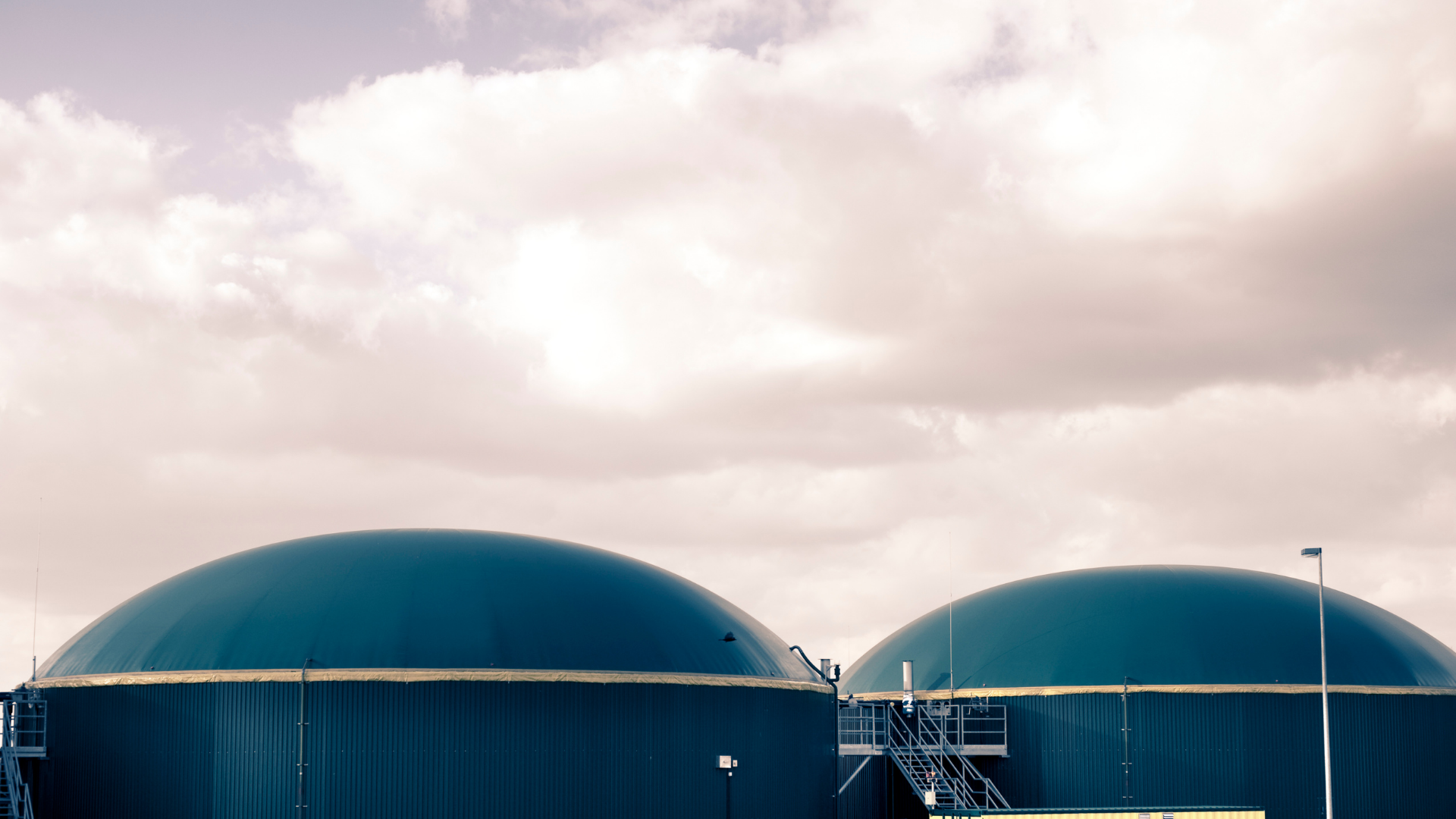
Biogas is a gaseous mixture dominated by methane (50-65 %) and CO₂ (35-45 %), with a handful of minor components that decide its quality and treatment cost: H₂S (50-6,000 ppmv), ammonia, siloxanes, VOCs, water vapour and traces. Methane is the energy; the rest are problems to manage. Its calorific value is around 6 kWh/Nm³ at 60 % methane. This article details what biogas contains depending on the substrate, why each contaminant matters and how it differs from biomethane.
Knowing exactly what is inside biogas is the starting point for operating, treating and valorising it. It is not pure methane: it is a mixture whose composition decides what can be done with it.
In short, biogas is methane + CO₂ + a set of minor contaminants. Methane is what gives value; the minor ones are what must be controlled so as not to damage engines, membranes or the grid.
This is the reference «what biogas contains»: the major components, the critical contaminants, the real calorific value and the difference from biomethane. It all stems from the process of what anaerobic digestion is.
Typical biogas composition by substrate
The composition is not fixed: it varies with the substrate and with how the digester is operated. These are the usual ranges:
| Component | Typical range | Comment |
|---|---|---|
| Methane (CH₄) | 50-65 % vol | The energetic component |
| Carbon dioxide (CO₂) | 35-45 % vol | Inert; dilutes the calorific value |
| Hydrogen sulphide (H₂S) | 50-6,000 ppmv | Depends on the substrate’s sulphur |
| Ammonia (NH₃) | 0-100 ppmv | Protein / nitrogen-rich substrates |
| Siloxanes | 0-50 mg/Nm³ | Above all in WWTP biogas |
| Water vapour | Saturation | Always present |
| Density relative to air | 0.8-0.9 | Slightly lighter than air |
Biogas from slurry or agro-industrial co-digestion is around 55-60 % methane; sludge biogas from a WWTP is similar but carries more siloxanes. The CH₄/CO₂ ratio is the first quality indicator.
Methane and carbon dioxide: the major components
Methane (CH₄) is the useful fraction: the fuel. The higher its percentage, the more energy per cubic metre. CO₂ is inert: it provides no energy and «dilutes» the calorific value of the biogas.
That is why the goal of operation is to maximise methane and, when biomethane is wanted, to separate the CO₂ in an upgrading stage. Raising methane from 60 % to 96 % is exactly what that process does.
Hydrogen sulphide (H₂S): the critical operational contaminant
H₂S is the contaminant that causes the most headaches day to day. It appears when the substrate contains sulphur (slurry, vinasse, industrial sludge) and its concentration ranges from 50 to 6,000 ppmv.
It is corrosive and toxic: it forms sulphuric acid on combustion, attacks engines and oils, and above certain thresholds it inhibits the digester itself. Reducing it is essential before cogeneration or injection. It is the subject of biogas desulphurisation.
Ammonia (NH₃) and other nitrogen compounds
Ammonia (NH₃) appears in biogas from nitrogen-rich substrates (concentrated slurry, protein waste), usually between 0 and 100 ppmv. In the gas phase it is less critical than H₂S, but it is corrosive and, in the digestate, its free form can inhibit methanogenesis.
Siloxanes: the hidden problem of WWTP biogas
Siloxanes are silicon compounds that arrive with WWTP sludge and urban waste (cosmetics, detergents). In wastewater-plant biogas they reach 0-50 mg/Nm³.
Their danger: on combustion they form abrasive silica that wrecks engines and turbines. They are the hidden contaminant of WWTP biogas because they cannot be detected by eye or with field sensors: they must be analysed by chromatography. For grid injection their limits are very strict (see biomethane EN 16723).
Volatile organic compounds (VOCs) and traces
In addition to the above, biogas carries traces of VOCs (volatile organic compounds), halogenated compounds and mercaptans, in very low concentrations but relevant for catalysts and for grid-injection limits. Their profile depends heavily on the substrate; landfill and WWTP biogas are the most loaded.
Water vapour and real calorific value
Biogas leaves the digester saturated with water vapour. That water condenses in the pipes, promotes corrosion (especially with H₂S) and reduces the calorific value, so it is almost always dried before use.
The calorific value depends on the methane percentage. Biogas with 60 % CH₄ has an LHV of around 21.5 MJ/Nm³, equivalent to ≈6 kWh/Nm³. The more methane, the more energy; CO₂ and water lower it.
Differences between raw biogas and biomethane
Raw biogas is what leaves the digester: 50-65 % methane with all its contaminants. Biomethane is that biogas purified to natural-gas quality (>96 % methane, contaminants at a minimum) to inject it into the grid or use it as fuel.
The difference is the treatment: raw biogas is used for cogeneration (electricity and heat) tolerating more impurities; biomethane requires separating the CO₂ and removing traces until it meets the standard. It is an important step up in quality (and in cost).
Frequently asked questions about biogas composition
What does biogas contain?
Biogas is a gaseous mixture composed mainly of methane (50-65 %) and carbon dioxide (35-45 %). It also contains minor components that condition its quality: hydrogen sulphide (H₂S, 50-6,000 ppmv), ammonia, siloxanes, volatile organic compounds, mercaptans and water vapour. Methane is the energetic fraction; the rest are impurities that must be controlled or removed.
Why is H₂S problematic in biogas?
Because it is corrosive and toxic. On combustion it forms sulphuric acid that contaminates the lubricating oil and attacks cogeneration engines; in addition, above certain thresholds it inhibits digestion itself inside the reactor. That is why it is removed before valorising the biogas, through desulphurisation in the digester or in the gas line. To inject biomethane into the grid, the limit is very low (≈5 mg/m³).
What are siloxanes and why do they matter?
Siloxanes are silicon compounds that reach biogas with wastewater-plant sludge and urban waste (they come from cosmetics and detergents). They matter because on combustion they form abrasive silica, which deposits on engines and turbines and wrecks them. They are especially problematic in WWTP biogas and very expensive to remove, above all if the destination is grid injection. They cannot be detected by eye: they require chromatography analysis.
What is the calorific value of biogas?
It depends on the methane percentage. Typical biogas with 60 % CH₄ has a lower heating value (LHV) of around 21.5 MJ/Nm³, equivalent to roughly 6 kWh per normal cubic metre (Nm³). The higher the methane proportion, the higher the calorific value; CO₂, which is inert, and water vapour reduce it. Biomethane (>96 % CH₄) approaches the calorific value of natural gas.
Smallops and biogas quality
Knowing your biogas composition is the first step to treating it well and not overpaying on consumables. At Smallops we characterise it and size the treatment with an Operational Excellence Diagnosis.
Do you know what is in your biogas?
Request a Smallops Operational Excellence Diagnosis: we measure your biogas’s real composition and tell you what treatment you need for your destination (cogeneration or grid).
References and standards
Rasi, S. et al. (2007). Trace compounds of biogas from different biogas production plants. Energy, 32 (8), 1375-1380. → doi.org/10.1016/j.energy.2006.10.018
Ryckebosch, E. et al. (2011). Techniques for transformation of biogas to biomethane. Biomass and Bioenergy, 35 (5), 1633-1645. → doi.org/10.1016/j.biombioe.2011.02.033
Andriani, D. et al. (2014). A review on optimization of biogas production from various natural sources. Applied Biochemistry and Biotechnology, 172, 1909-1928. → doi.org/10.1007/s12010-013-0652-x
IEA Bioenergy (2021). Biogas: pathways to 2030. → ieabioenergy.com