
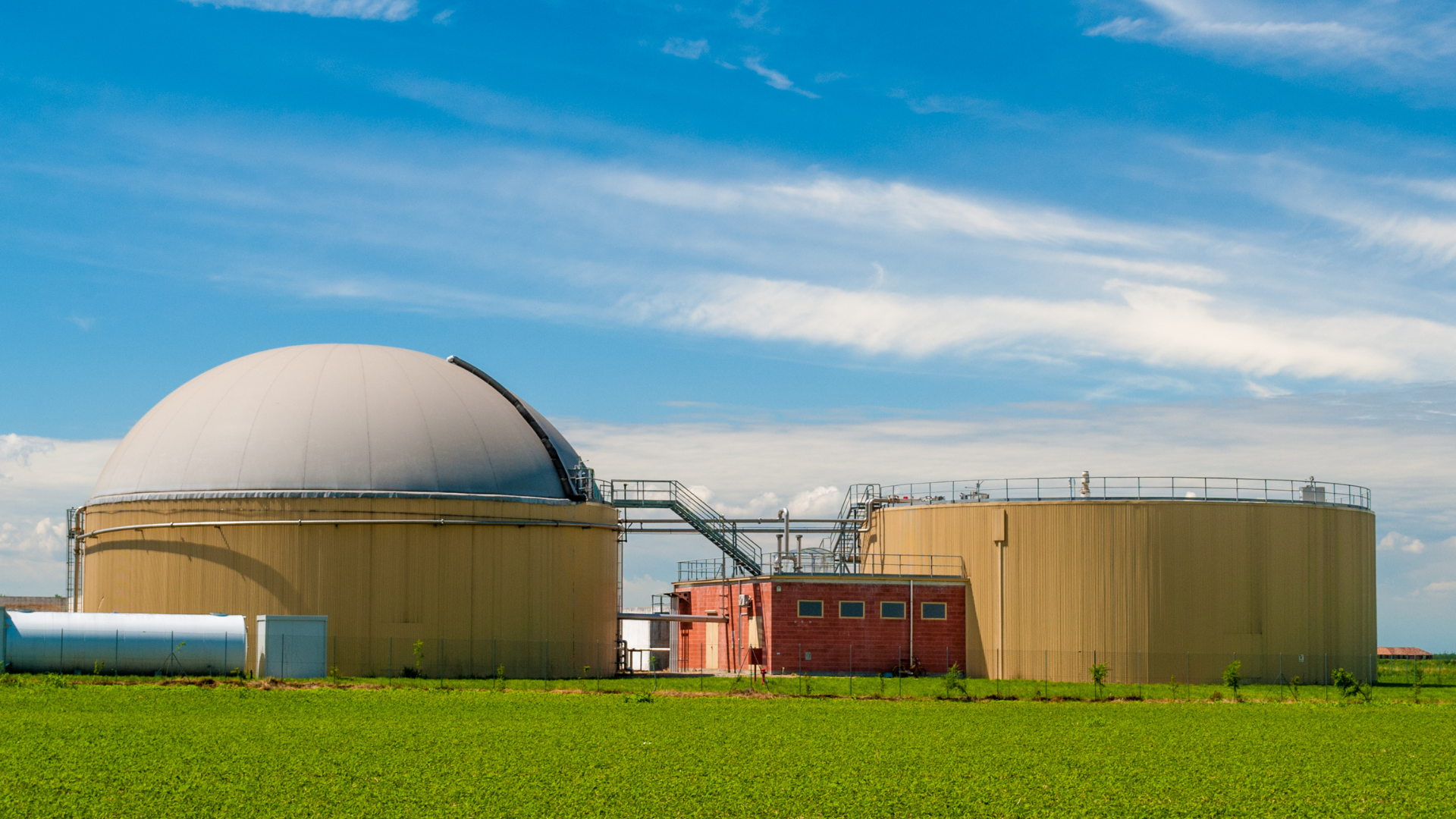
Biomethane EN 16723 is biogas purified to natural-gas quality for injection into the grid. In Spain, the binding specification for injection is set by the gas system Technical Management Rules (NGTS, Order TED/181/2025), which refer to EN 16723-1 for siloxanes: Wobbe index between 13.403 and 16.058 kWh/m³, CO₂ ≤ 2.5%, oxygen ≤ 0.01% and limited traces of H2S, siloxanes and water. Reaching them is not only a matter of the upgrading equipment: biomethane quality starts in the digester. The dirtier the biogas comes in, the more expensive it is to clean. This article summarises what the standard requires, the critical parameters, the upgrading technologies and why siloxanes are the contaminant that causes the most headaches.
Biomethane EN 16723 can be the most profitable destination for biogas when there is a natural gas grid nearby: it is sold as renewable gas, with guarantees of origin (Royal Decree 376/2022) managed by Enagás GTS. But the jump from biogas to grid biomethane comes with a demanding regulatory bar.
The European standard EN 16723 harmonises biomethane quality, but in Spain what can be injected is set by Table 4 of the NGTS (Order TED/181/2025), which refers to EN 16723-1 for siloxanes. And its limits are much stricter than what a cogeneration engine tolerates.
Here «more or less clean» is not enough: either you meet every parameter, or you don’t inject. This article explains what the standard requires, how you get there and where the real cost lies.
What the biomethane EN 16723 standard requires (part 1 and part 2)
EN 16723 has two parts. Part 1 regulates biomethane for injection into the grid of natural gas. Part 2 regulates it as an automotive fuel.
Part 1 adds limits specific to biomethane (siloxanes, CO, ammonia, amines) and refers to EN 16726 for the remaining parameters; part 2 sets the full specification as a vehicle fuel. The grid-injection one is what affects most plants making the jump.
The underlying idea: biomethane has to behave like natural gas in the grid. Wobbe index and calorific value within the natural gas range, the same safety and without damaging pipes or consumers’ equipment.
The 12 critical parameters of biomethane EN 16723
Beyond methane, the specification monitors a dozen parameters. These are the NGTS limits (Order TED/181/2025, Table 4) that decide whether a plant injects or not in Spain:
| Parameter | Spanish NGTS limit (Table 4) | Why it matters |
|---|---|---|
| Wobbe index | 13.403-16.058 kWh/m³ | Interchangeability with natural gas |
| CO₂ | ≤ 2.5 mol% (4% in networks ≤ 16 bar without reverse flow) | Dilutes the calorific value |
| Oxygen (O₂) | ≤ 0.01 mol% (1% in networks ≤ 16 bar without reverse flow) | Corrosion risk and grid safety |
| H₂S + COS (as S) | ≤ 15 mg/m³ | Corrosion and toxicity |
| Total sulphur | ≤ 50 mg/m³ | Odour, corrosion, catalysts |
| Siloxanes (volatile silicon, as Si) | 0.3-1 mg/m³ (according to EN 16723-1) | Abrasive silica in consumer equipment |
| Water dew point | +2 °C at 70 bar | Prevents condensation and corrosion |
| Ammonia (NH₃) | ≤ 10 mg/m³ | Corrosion |
| Halogenated compounds | Fluorine ≤ 10 mg/m³; chlorine ≤ 1 mg/m³ | Corrosion and combustion by-products |
| Mercaptans (RSH, as S) | ≤ 17 mg/m³ | Odour and corrosion |
| Dust and particles | Technically pure | Grid clogging |
| Hydrogen (H₂) | ≤ 2 mol% | Gas system compatibility |
Values at reference conditions of 0 °C and 1.01325 bar. The extended limits for oxygen (1%) and CO₂ (4%) only apply in networks of up to 16 bar without reverse flow to the transmission grid and with a water dew point not above -8 °C at 70 bar. The siloxane limit is set according to EN 16723-1. Before designing the upgrading, confirm the conditions of your injection point with the operator.
Upgrading technologies: PSA, scrubbing, membranes, cryogenic
Upgrading separates the CO₂ (and fine-tunes traces) so that the gas meets the Wobbe index and the CO₂ limit of the grid. Four families dominate the market.
- PSA (pressure swing adsorption): sieves that retain the CO₂. Mature and modular, good for medium-sized plants; it loses some methane in the purge.
- Water or amine scrubbing: washes the CO₂ in a column. High efficiency; the amine one recovers almost all the methane, but consumes heat.
- Membranes: separate the CO₂ by permeability. Compact, chemical-free and scalable; the most widespread in new plants.
- Cryogenic: liquefies to separate. Very pure and it allows selling liquid CO₂, but with high CAPEX; for large plants.
All of them need polishing stages for H2S, siloxanes and water. Upgrading raises the methane; polishing guarantees the traces.
Why the quality of the incoming biogas decides the OPEX
The expensive mistake is to design the upgrading as if the incoming biogas were stable and clean. It is not.
If the biogas arrives with a lot of H2S or siloxanes, the polishing stages (activated carbon, beds) saturate sooner and the replacement cost soars. Upstream biogas desulphurisation is not optional: it protects the upgrading.
The operational rule: every mg of H2S or siloxane you avoid in the digester is money you don’t spend on polishing consumables. Biomethane quality starts in the digester’s diet, not in the membrane.
This is especially true in biogas at WWTPs and in co-digestion with sulphur-bearing substrates, where the contaminant regime changes with the diet.
Siloxanes in biomethane EN 16723: the critical contaminant
Siloxanes are silicon compounds that arrive with certain substrates (WWTP sludge, OFMSW with cosmetics and detergents). In combustion they form abrasive silica that destroys engines and turbines.
For grid injection the limit is very low: between 0.3 and 1 mg Si/m³, according to EN 16723-1. It is one of the hardest and most expensive parameters to meet.
They are removed with specific activated carbon or regenerable beds, and measured by gas chromatography after cartridge capture. They cannot be detected by eye: they have to be analysed.
Frequently asked questions about biomethane EN 16723
What is the EN 16723 standard and what does it require?
EN 16723 is the European standard that defines biomethane quality. Part 1 regulates injection into the natural gas grid and part 2, use as an automotive fuel. In Spain, injection is governed by the NGTS (Order TED/181/2025), which refer to EN 16723-1 for siloxanes: Wobbe index 13.403-16.058 kWh/m³, CO₂ ≤ 2.5 mol%, O₂ ≤ 0.01 mol% (1% in networks ≤ 16 bar without reverse flow), H2S + COS ≤ 15 mg/m³ and siloxanes 0.3-1 mg Si/m³, among other parameters.
What are the main contaminants in the upgrade to biomethane?
The ones that most drive the cost are CO₂ (separated in the upgrading), H2S and total sulphur, siloxanes (especially in WWTP sludge and OFMSW), water (dew point) and oxygen. Siloxanes are usually the bottleneck because of their very low limit and their removal cost.
Which upgrading technology is best?
It depends on size and context. Membranes are today the most common in new plants because they are compact and chemical-free; PSA is solid in medium-sized plants; amine scrubbing maximises methane recovery at the cost of thermal consumption; and cryogenic pays off in large plants that want to sell liquid CO₂. The choice is made against the flow rate, the inlet quality and the destination of the CO₂.
How is the presence of siloxanes measured?
Siloxanes are captured in an adsorbent or solvent cartridge and analysed by gas chromatography with mass spectrometry (GC-MS). Unlike H2S, they are not usually measured with field sensors but by sampling and laboratory analysis. In plants with WWTP sludge it is advisable to measure them periodically, because their concentration varies with the diet.
How Smallops audits the biogas-biomethane chain
Meeting EN 16723 cost-effectively is a whole-chain problem, from the digester to the membrane. A biogas plant diagnosis measures the real contaminant regime, sizes the polishing and avoids consumable cost overruns.
Are you making the jump to grid biomethane?
Before investing in upgrading, audit the quality of your incoming biogas. Request a Smallops Operational Excellence Diagnosis and we calculate what you need to meet EN 16723 without paying more than necessary.
References and standards
Order TED/181/2025, of 13 February, approving the Technical Management Rules of the Spanish Gas System (BOE no. 50, 27 February 2025), section 2.5.2.2, Table 4.
EN 16723-1:2016. Natural gas and biomethane for use in transport and biomethane for injection in the natural gas network. Part 1: Specifications for biomethane for injection in the natural gas network.
EN 16723-2:2017. Natural gas and biomethane for use in transport and biomethane for injection in the natural gas network. Part 2: Automotive fuels specification.
Adnan, A.I. et al. (2019). Technologies for biogas upgrading to biomethane: a review. Bioengineering, 6 (4), 92. doi.org/10.3390/bioengineering6040092