
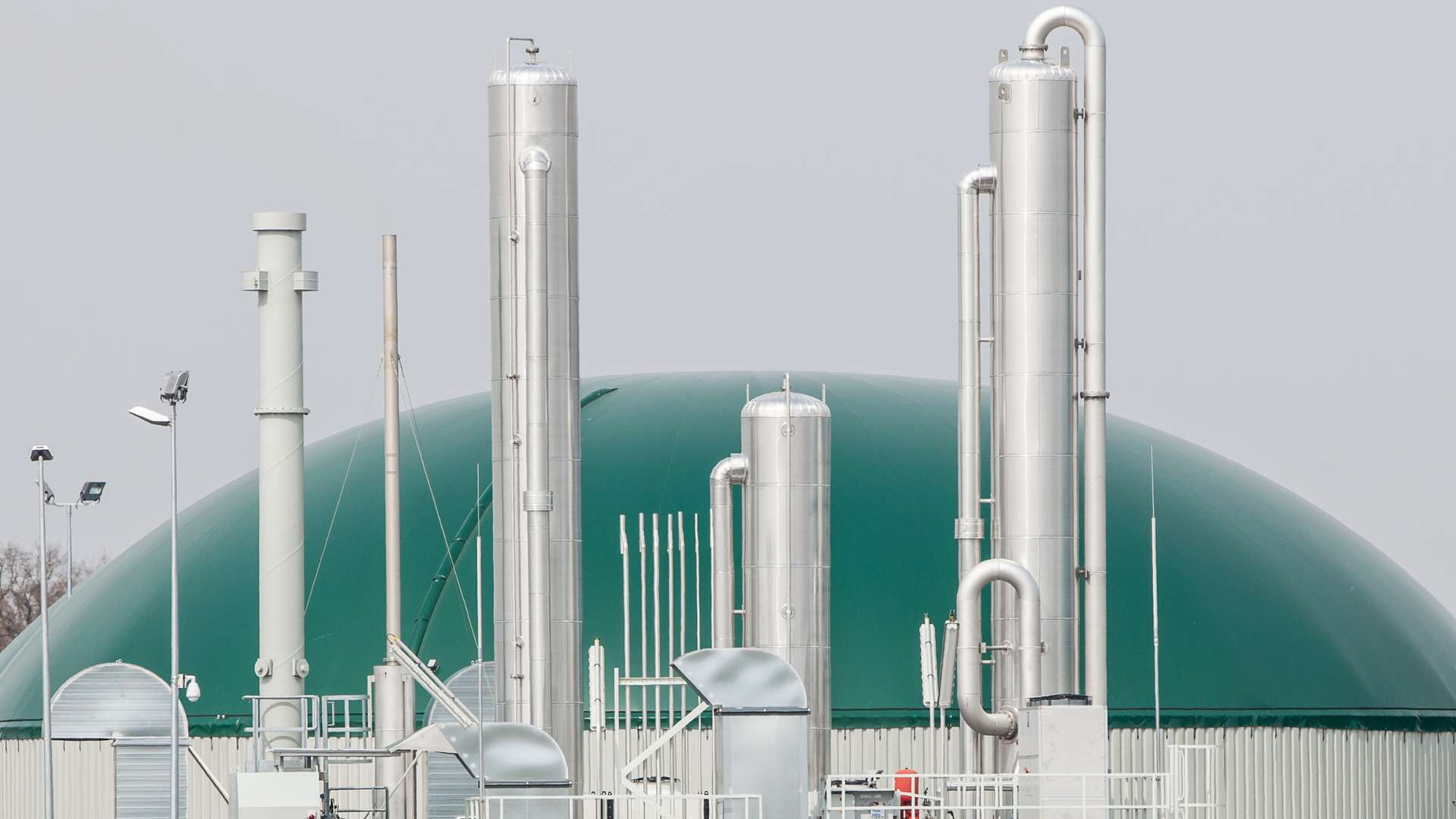
Biogas desulphurisation can be done inside the digester (precipitating sulphides with iron salts or using conductive nanoparticles) or downstream, in the gas line (impregnated activated carbon, biofilters, chemical scrubbers). The correct technical decision is not choosing one or the other: it is understanding which fits your plant’s H2S regime, the engine or biomethane-grid specification, and the total 5-year cost. This article describes the four main methods, their operating ranges, the thresholds that trigger each one and an operational case.
Biogas desulphurisation is one of the most important hidden costs in plants with sulphur-rich substrates, and at the same time it is one of the processes where the most poorly made default technical decisions are seen: the plant inherited one system or another from the original engineering, and no one questioned again whether it was still the right one when the digester diet changed.
The problem is not that H2S is hard to remove. The problem is that there are four reasonable technologies, each with its operating range, its OPEX cost and its Achilles heel, and the economic difference between the right option and the wrong one can mean exceeding €40,000 a year in a medium-sized plant.
This article describes the four main methods (iron salts in the digester, activated carbon, biofilters, scrubbers), the operating thresholds that trigger each one, the H2S specifications required by cogeneration and the biomethane grid, and a simple protocol to decide which fits your plant.
Why H2S is the silent enemy of biogas
Hydrogen sulphide (H2S) is the natural by-product of anaerobic digestion when the substrate contains sulphur. And almost all common substrates contain sulphur.
Proteins contain cysteine and methionine (sulphur-bearing amino acids). Slurry carries sulphates from the animal diet. Industrial wastewater can bring sulphates at high concentrations. The sulphate-reducing bacteria (SRB) present in the anaerobic consortium reduce that sulphur to sulphide, part of which leaves as gas in the biogas.
H2S levels vary a lot between plants (in the literature, from about 80 to more than 4,000 ppmv depending on the substrate). These are indicative values by substrate type:
| Substrate | Typical H2S in biogas | Main cause |
|---|---|---|
| Pig slurry | 800-3,500 ppmv | Dietary sulphate + cysteine/methionine |
| WWTP sludge | 200-1,200 ppmv | Water with industrial sulphates upstream |
| Fruit and vegetable waste | 50-300 ppmv | Low sulphur input |
| Vinasse | 2,000 to more than 10,000 ppmv | Sulphates from the sugar process |
| Balanced agro-industrial co-digestion | 300-1,500 ppmv | Attenuated mix |
H2S has three operational impacts that accumulate at the same time:
- Accelerated corrosion in cogeneration engines, pipes, heat exchangers and the flare. The sulphide combines with the combustion water to form sulphuric acid that attacks lubricating oils and metal surfaces.
- Intra-digester inhibition when the dissolved sulphides in the digestate reach the inhibition range (in the order of 100-800 mg S/L of dissolved sulphide, depending on pH and temperature): methanogenesis slows down without explicit decoupling and specific productivity drops.
- Regulatory non-compliance for biomethane injection into the grid. In Spain, the gas system Technical Management Rules (NGTS, Order TED/181/2025, Table 4) limit H2S + COS in injected biomethane to 15 mg S/m³ (≈10.5 ppmv of H2S at 0 °C) and total sulphur to 50 mg S/m³.
Desulphurisation in the digester: iron salts and nanoparticles
The oldest and most economical strategy in the sector is to attack the problem before it forms: precipitate the sulphides inside the digester so they don’t leave in the gas phase. Three approaches work.
Ferric chloride (FeCl3) and ferrous chloride (FeCl2)
Iron salts dissolved in water that are dosed into the digester. The Fe²⁺ or Fe³⁺ reacts with the sulphide forming insoluble iron sulphide (FeS), which precipitates and leaves with the digestate. The stoichiometric dose is 1.74 mg of Fe per mg of S with a ferrous salt and 1.16 mg with a ferric salt; in practice an excess of 1.7 to 5 times is applied, because phosphate and organic matter also consume iron.
Advantages: cheap, it markedly reduces H2S in biogas (in practice, down to 100-200 ppmv; going lower requires a large excess of iron), and it simultaneously reduces dissolved sulphides below the intra-digester inhibition threshold.
Limitations: the salt adds chlorides to the digestate (an agronomic problem if they build up), it corrodes equipment if the dosing is not well designed, and the effective dose varies greatly with the digester diet (it requires periodic recalibration).
Zero-valent iron (Fe⁰) and encapsulated iron nanoparticles
A more recent approach: introduce iron in reduced metallic form, not as a dissolved salt. The mechanism combines sulphide precipitation with an additional effect on direct interspecies electron transfer (DIET) in the methanogenic consortium.
Iron nanoparticles encapsulated in a carbonaceous matrix (Smallops proprietary technology) are a variant where the Fe⁰ is protected against premature oxidation and released in a controlled way in the digester. Operational efficacy data measured at an industrial plant: 99% H2S removal in biogas when dosed at 2-3 kg/t VS.
Advantages: very high H2S removal, no chloride input, and a favourable secondary effect on methanogenic kinetics via DIET.
Limitations: a higher cost per kg than iron salts. The decision to apply nanoparticles must go through the additives protocol that filters when it pays off versus a conventional salt.
Desulphurisation in the gas line: activated carbon, biofilters, scrubbers
The complementary strategy, and in most cases a necessary one, is to let the H2S form and remove it afterwards, on the biogas’s way to the engine or the upgrading unit. Three technologies cover the market.
Impregnated activated carbon
The biogas passes through a bed of activated carbon impregnated with KI (catalyst), alkalis (KOH, NaOH) or metal oxides, which with a small dose of oxygen convert the H2S into elemental sulphur retained in the carbon’s pores.
Typical operating capacity: 0.15 to 0.40 g of S per g of activated carbon, depending on the brand and the regime.
Advantages: a very mature technology, low CAPEX, effective removal down to fine polishing, ideal as a final stage before cogeneration or biomethane.
Limitations: the carbon saturates and must be replaced or regenerated periodically. OPEX shoots up when the inlet H2S concentration is high: the bed saturates in weeks and the replacement cost becomes prohibitive.
Biofilters (biological desulphurisation)
A biological support bed colonised by sulphide-oxidising bacteria (typically Thiobacillus) that oxidise the H2S to elemental sulphur or sulphate in the controlled presence of oxygen (controlled air dosing, in the order of 4-10% of the biogas flow in external biofilters).
Advantages: very low OPEX (the bacteria are not “consumed”), usual efficacy above 90% in slurry and WWTP biogas. Suitable for medium and high H2S concentrations in continuous flows.
Limitations: it requires control of the micro-aeration (excess oxygen kills bacteria or is explosive), it does not reach the fine polishing that the biomethane grid demands (it usually leaves tens of ppmv residual), and it needs an initial acclimation period.
Chemical scrubbers (washing with NaOH or chelated Fe)
The biogas is washed in an absorption column with a reactive liquid that captures the H2S. The two most widespread variants are washing with caustic soda (NaOH) and the chelated-iron system (Fe-EDTA or Fe-NTA).
Advantages: high efficacy (>99%) and it can handle very high H2S concentrations (up to 10,000 ppmv). The chelated-Fe system is regenerable: the sulphur is recovered and can be valorised.
Limitations: high CAPEX, OPEX dependent on reagent consumption (NaOH) or regeneration energy (chelated Fe). A technology that only pays off in large plants with very high H2S.
How to choose: digester vs gas line decision matrix
The correct question is not “which technology is best”. It is: “which technology is the right one for my H2S regime, my biogas destination and my economic horizon”. This matrix summarises the most efficient combination for the four typical scenarios.
| Scenario | H2S in biogas | Biogas destination | Recommended combination |
|---|---|---|---|
| Low and stable | <500 ppmv | Cogeneration | Activated carbon in the line only |
| Medium | 500-1,500 ppmv | Cogeneration | Fe in the digester + polishing activated carbon |
| High | 1,500-3,500 ppmv | Cogeneration | Fe in the digester + biofilter |
| Any | Any | Biomethane grid | Dual treatment: digester + scrubber + final carbon |
In plants that treat slurry biogas, the usual scenario is “high” or “medium”. In plants that produce biogas at WWTPs, it is typically “low” or “medium”. And when the destination is the biomethane grid, the decision is no longer “one or the other” but “all at once” because the NGTS limit (15 mg S/m³ of H2S + COS) is hard to reach with a single stage.
H2S specifications for cogeneration and biomethane
The two biogas valorisation routes impose very different thresholds of allowable H2S. Designing the desulphurisation without knowing the exact threshold is the main cause of cost overruns in this area.
Cogeneration with an internal combustion engine
The allowable threshold is set by each manufacturer in the fuel-gas specifications of its engine; the literature places the usual tolerance below 500 ppmv, with models that require less than 50 ppmv. The lower it is kept, the longer the service life of the lubricating oil and the internal components.
Operating with H2S above the specification shortens oil-change intervals and increases oil and labour costs. In the medium term, the real cost is the loss of operating hours through premature wear.
Injection into the biomethane grid (NGTS and EN 16723-1)
In Spain, injected biomethane must comply with the NGTS (Order TED/181/2025, section 2.5.2.2, Table 4): H2S + COS ≤ 15 mg S/m³, equivalent to about 10.5 ppmv of H2S at 0 °C, and total sulphur ≤ 50 mg S/m³. EN 16723-1 refers these parameters to EN 16726. It is more than an order of magnitude stricter than cogeneration.
This threshold is only reached with fine polishing treatment, typically high-quality activated carbon or a regenerable chemical scrubber. Any plant considering the jump to biomethane must redesign its desulphurisation line: cogeneration solutions are rarely sufficient.
Operational case: 800 kWe plant with pig slurry and vinasse
An 800 kWe cogeneration plant (mesophilic 38 °C), mixed diet: 60% pig slurry, 25% local vinasse, 15% maize silage.
Initial symptom. Average H2S in biogas 2,800 ppmv (high zone due to the slurry + vinasse combination). At rated power, the engine consumes about 365 Nm³/h of biogas (40% electrical efficiency, 55% methane), which at 2,800 ppmv means about 32 kg of sulphur a day, almost 12 t a year. Inherited system: activated carbon in the line only. With retention capacities of 0.15 to 0.40 g of S per g of carbon, that load requires in the order of 30 to 80 t of carbon a year.
In addition: engine oil changes every 900 hours (vs 1,800 nominal).
Operational Excellence Diagnosis
The analytical characterisation identified that the vinasse contributed 70% of the system’s total sulphur (high sulphate content from the sugar process). The methanogenic consortium was also operating with dissolved sulphides around 240 mg S/L, in an incipient inhibition zone. Historical specific productivity: 0.31 Nm³ CH4/kg VS (≈10% below the diet’s theoretical potential).
Technical intervention
Two coordinated changes.
One: incorporate desulphurisation in the digester with encapsulated iron dosing at 2.5 kg/t VS. A dual mechanism: sulphide precipitation (reduces the biogas H2S) + DIET effect on methanogenesis (recovers productivity).
Two: keep activated carbon in the line as a final polishing stage, not as the main mechanism. Reducing the load on the carbon extends its service life drastically.
Result at 6 months
Consolidated results at 6 months
H2S in biogas: 2,800 → 28 ppmv (–99%)
Dissolved sulphides in digestate: 240 → 95 mg S/L (stable zone)
Specific productivity recovered: 0.31 → 0.35 Nm³ CH4/kg VS (+13%)
Activated carbon consumption: from 30-80 t/year to less than 1 t/year (at 28 ppmv the filter only retains about 120 kg of sulphur a year)
Engine oil-change interval: 900 → 1,700 hours
Frequently asked questions about biogas desulphurisation
Is it better to desulphurise in the digester or in the gas line?
It depends on the H2S regime and the biogas destination. For concentrations below 500 ppmv and cogeneration, activated carbon in the line is the most efficient option. For medium and high concentrations (>500 ppmv), combining digester desulphurisation (iron salts or Fe nanoparticles) with a subsequent polishing is more economical over 5 years. For biomethane injection into the grid, practically all plants need combined treatment because of the regulatory requirements (in Spain, H2S + COS ≤ 15 mg S/m³, about 10.5 ppmv).
How does H2S affect the cogeneration engine?
H2S in biogas is transformed during combustion into sulphuric acid that contaminates the lubricating oil and accelerates the corrosion of internal components. Operating with H2S above the manufacturer’s specification shortens the oil-change interval and makes maintenance more expensive. In the long term, it also reduces the engine’s service life.
What is the correct FeCl3 dose for desulphurisation?
The stoichiometric iron dose is 1.16 mg of Fe per mg of S with ferric chloride (FeCl3) and 1.74 mg with ferrous chloride; in practice an excess of 1.7 to 5 times that figure is applied. The exact dose depends on the digester pH (it affects the fraction of dissolved vs gaseous sulphide), the phosphate concentration (it competes for the Fe³⁺) and the real sulphur regime. A periodic analytical characterisation is the minimum practice for the dose to remain efficient and not translate into reagent cost overruns or excess chlorides in the digestate.
What H2S specification does the biomethane grid require?
In Spain, the NGTS (Order TED/181/2025) limit H2S + COS in injected biomethane to 15 mg S/m³, about 10.5 ppmv of H2S, and total sulphur to 50 mg S/m³; EN 16723-1 refers these parameters to EN 16726. It is a much stricter threshold than what cogeneration engines tolerate and is only reached with fine polishing treatment: high-quality activated carbon or a regenerable chemical scrubber. Any plant considering the jump to biomethane must redesign its desulphurisation line from scratch.
Is your desulphurisation sized for your plant’s current diet?
A poor desulphurisation strategy costs between €20,000 and €40,000 a year in medium-sized plants. Request a Smallops Operational Excellence Diagnosis: we characterise the real H2S regime, calculate the total 5-year cost and propose the most efficient digester-line combination for your case.
References and standards
EN 16723-1:2016. Natural gas and biomethane for use in transport and biomethane for injection in the natural gas network. Part 1: Specifications for biomethane for injection in the natural gas network.
Order TED/181/2025, of 13 February, approving the Technical Management Rules of the Spanish Gas System (BOE no. 50, 27 February 2025), section 2.5.2.2, Table 4.
Danish Technological Institute (2014). Biogas upgrading. Evaluation of methods for H2S removal.
Wellinger, A. & Lindberg, A. Biogas Upgrading and Utilisation. IEA Bioenergy Task 24. ieabioenergy.com
Zicari, S.M. (2003). Removal of Hydrogen Sulfide from Biogas using Cow-manure Compost. Cornell University. ecommons.cornell.edu/handle/1813/8782
Khoshnevisan, B. et al. (2021). A critical review on livestock manure biorefinery technologies: Sustainability, challenges, and future perspectives. Renewable and Sustainable Energy Reviews, 135, 110033. doi.org/10.1016/j.rser.2020.110033