
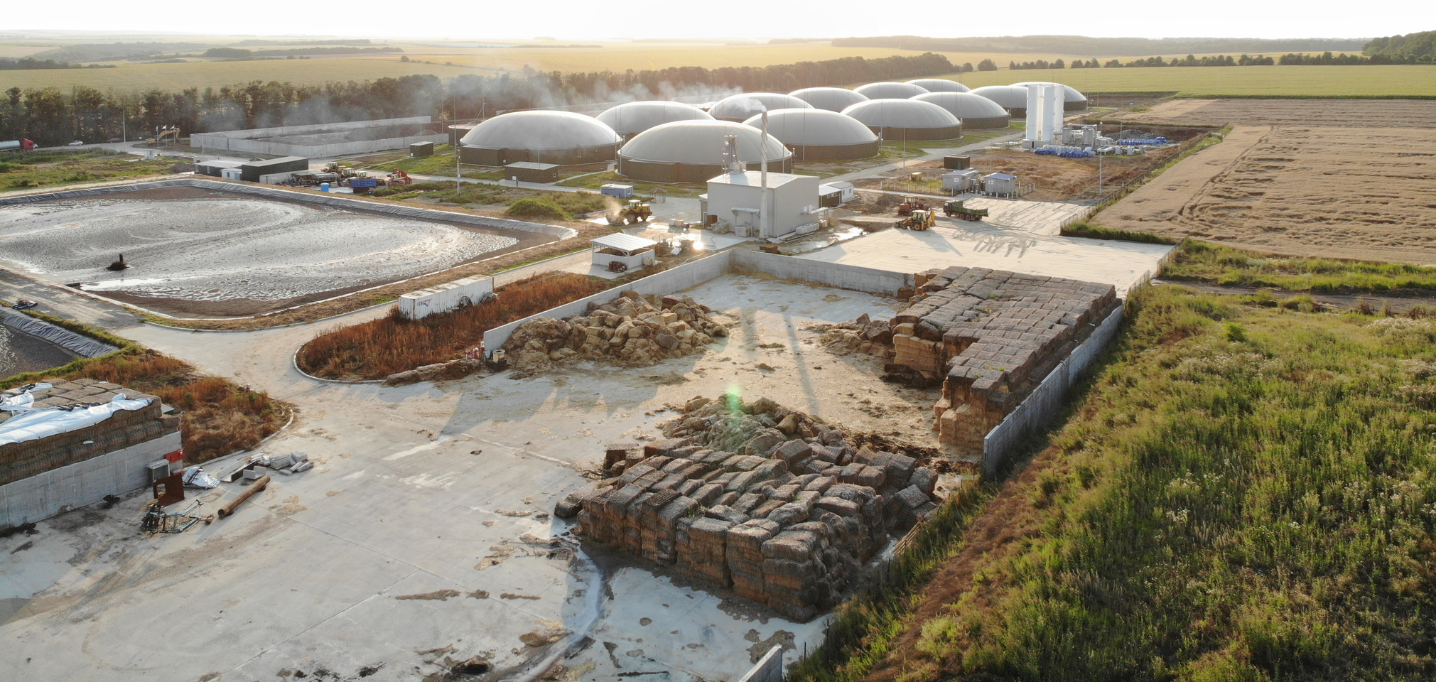
Adding a new substrate to the digester is one of the highest-risk moments of a biogas plant: done badly, it acidifies the reactor in days. The safe protocol has five steps: characterise the substrate (VS, C/N, BMP, inhibitors), run a preliminary test, add it with a gradual ramp (0.2-0.5 kg VS/m³·day per week, starting below 10-15 % of the diet), monitor the sentinel variables (FOS/TAC, propionic acid, methane) and give the consortium 4-8 weeks to acclimatise. This article details each step and the mistakes that ruin operation.
Changing a digester’s diet (adding a fat, a silage, a vinasse or an agro-industrial by-product) is the most direct way to raise production. It is also the manoeuvre that acidifies the most digesters when it is done in a hurry.
The microbial consortium does not adapt from one day to the next: it needs time and a controlled incorporation. Improvising here is expensive.
This is the step-by-step protocol to add a new substrate without slowing down the digester. It builds on the fundamentals of what anaerobic co-digestion is.
Why adding a substrate is a critical moment
A new substrate suddenly changes the digester’s balance: it usually adds more load, another nutrient profile and, often, compounds that the consortium is not used to degrading. The acidogenic bacteria, which are fast, adapt right away; the methanogenic archaea, which are slow, do not.
That gap is the danger: if too much substrate is fed at once, the volatile fatty acids (VFA) accumulate faster than they are consumed, the pH drops and the reactor acidifies. That is why incorporation is not improvised: it is planned.
Step 1 · Characterise the substrate before feeding it
You never add a substrate «by eye». First you have to know its key parameters:
- Total and volatile solids (TS, VS): to calculate how much real load it adds.
- C/N ratio: to know whether it balances or unbalances the diet.
- BMP (biochemical methane potential): how much methane it can give.
- Potential inhibitors: fats (risk of LCFA inhibition), nitrogen (ammonia), salts, heavy metals or antibiotics.
Step 2 · Preliminary test: BMP and compatibility test
Before modifying the industrial digester it is worth a laboratory-scale test. The BMP (VDI 4630) test measures the real methane of the substrate and, above all, detects whether it causes negative effects on the microbial system: if methane production stalls in the test, it will also stall in the plant.
A co-digestion test (mixing the new substrate with the base one) reveals synergies and antagonisms before risking the real reactor. It is the cheapest way to avoid an expensive scare.
The BMP has a limit: it is a batch test that measures the maximum potential under ideal conditions, but not how the substrate behaves when fed day by day. That is what the semi-continuous test is for: a laboratory reactor fed continuously over weeks, which reproduces real operation and reveals the kinetics, the tolerance to load, the inhibitions and the acclimatisation time. It is the most reliable validation before scaling up.
Step 3 · Gradual incorporation ramp
The golden rule is to add the substrate little by little. Practical recommendations:
- Start with a small fraction of the energetic co-substrate, below 10-15 % of the VS of the diet.
- Raise the load in increments of 0.2-0.5 kg VS/m³·day per week, not all at once.
- Keep each level for several days before raising it, checking that the process responds well.
This ramp is linked to the organic loading rate: adding a substrate is, in practice, raising the OLR in a controlled way.
Step 4 · Monitoring during the transition
While raising the load, you have to monitor the sentinel variables more frequently than usual:
- FOS/TAC: stable below 0.4; between 0.4 and 0.6 you have to slow down; above 0.6-0.8, alarm.
- Propionic acid: it is the earliest indicator; if it starts to rise, the process is becoming unbalanced.
- Biogas production and quality: methane should rise proportionally to the load; if not, something is wrong.
If any of these signals spikes, the increase is stopped, and it can even be reduced again, until the process recovers. It is the core of stabilising the anaerobic digester.
Step 5 · Acclimatisation of the consortium
After reaching the target dose, the consortium needs time to fully adapt: normally 1-2 HRT. During that period the microbial population readjusts, the species capable of degrading the new substrate grow and performance stabilises.
Rushing at this point (raising more before the consortium has acclimatised) is a frequent mistake: the digester seems to hold, but it is at the limit and collapses at the first disturbance.
Common mistakes when adding substrates
- Introducing it all at once to «see what happens»: the most common cause of acidification.
- Not characterising or testing the substrate beforehand.
- Ignoring inhibitors: a fat or a protein-rich substrate can block the process even if its BMP is high.
- Not allowing acclimatisation time between increases.
- Lowering monitoring just when it is most needed, during the transition.
Frequently asked questions about substrate incorporation
How do you add a new substrate to a digester?
With a gradual protocol: first you characterise the substrate (VS, C/N, BMP, inhibitors) and test it at laboratory scale (BMP and, if the diet requires it, a semi-continuous assay); then you add it little by little, starting below 10-15 % of the VS of the diet and raising 0.2-0.5 kg VS/m³·day per week, while monitoring FOS/TAC, propionic acid and methane production. It is never fed all at once.
How long does the digester take to adapt to a new substrate?
The microbial consortium normally needs between 4 and 8 weeks (depending on the HRT) to fully acclimatise to a new substrate. Acidogenic bacteria adapt in a few days, but the methanogenic archaea, which are slow, take several weeks. That is why incorporation must be gradual and respect that time before raising the load further.
What analyses do I need before adding a co-substrate?
As a minimum: total and volatile solids (TS, VS), C/N ratio and methane potential (BMP). It is also worth assessing possible inhibitors depending on the substrate type: fats (LCFA), nitrogen (ammonia), salts or toxics. A BMP test in co-digestion anticipates the potential; the most reliable way to know how it will behave in the real digester (tolerable load, inhibitions, acclimation) is to validate it afterwards with a semi-continuous laboratory assay.
What happens if I add the substrate too fast?
The acidogenic bacteria produce volatile fatty acids faster than the methanogens consume them. The VFA accumulate, the pH drops and the digester acidifies, with a fall in methane production and, in severe cases, a biological shutdown that takes weeks to recover from. That is why incorporation must always be gradual.
Smallops and substrate incorporation
Every new substrate is a production opportunity, but also a risk. At Smallops we characterise the substrate, test its compatibility and design the incorporation ramp with an Operational Excellence Diagnosis.
Are you going to add a new substrate?
Request a Smallops Operational Excellence Diagnosis: we characterise the substrate, assess its compatibility with your digester and design the safe incorporation ramp to gain production without acidifying the reactor.
References and standards
Mata-Alvarez, J. et al. (2014). A critical review on anaerobic co-digestion: achievements between 2010 and 2013. Renewable and Sustainable Energy Reviews, 36, 412-427. → doi.org/10.1016/j.rser.2014.04.039
Holliger, C. et al. (2016). Towards a standardization of biomethane potential tests. Water Science and Technology, 74 (11), 2515-2522. → doi.org/10.2166/wst.2016.336
Labatut, R.A. et al. (2011). Biochemical methane potential and biodegradability of complex organic substrates. Bioresource Technology, 102 (3), 2255-2264.
VDI 4630 (2016). Fermentation of organic materials. Verein Deutscher Ingenieure.