
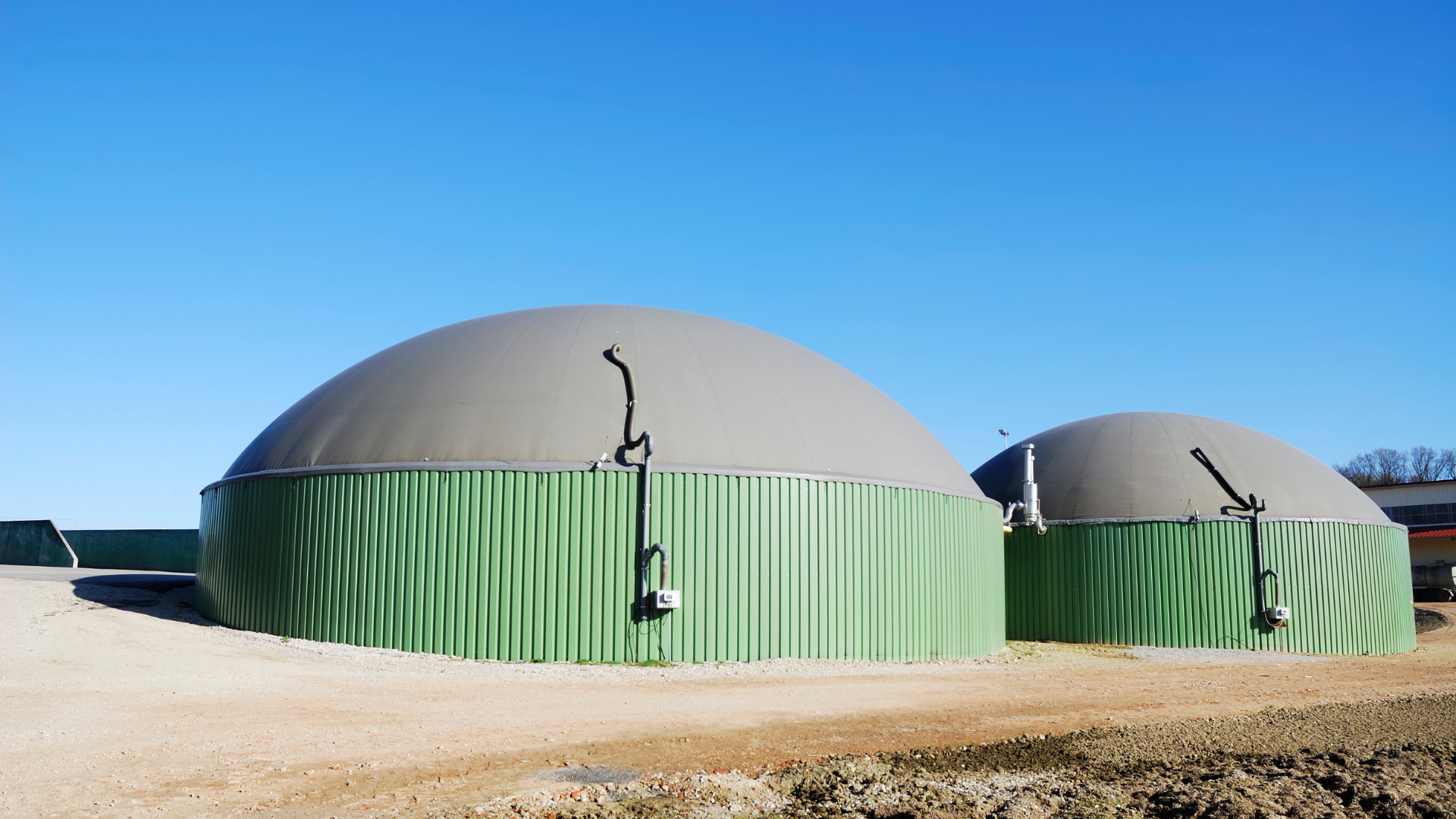
Temperature is the most critical environmental variable of an anaerobic digester. A mesophilic digester works at 35-40 °C with a practical tolerance of ±2 °C; a thermophilic one, at 50-55 °C with only ±1 °C. Methanogenic archaea are very sensitive to oscillations: a 5 °C deviation can cut production by up to 40 % and recovery takes 2 to 4 weeks. Keeping the temperature stable (well-sized heating, cross-checked probes and continuous logging) matters more than the exact setpoint value.
Of all the variables controlled at a biogas plant, temperature is the most important. The microbial consortium can adapt (slowly) to changes in diet or load, but it responds poorly to thermal swings.
The absolute value is the oscillation. A digester stable at 38 °C produces more than one oscillating between 36 and 40 °C, even if the average is the same.
This article reviews the safe ranges, the usual heating systems, the causes of thermal drifts and how to act when temperature is lost. It builds on what anaerobic digestion is.
Why digester temperature matters critically
Anaerobic digestion is a chain of biological reactions and each microbial group has its thermal optimum. The most sensitive are the archaea responsible for methanogenesis, since their activity falls disproportionately when the temperature moves away from the setpoint.
In addition, temperature shifts the chemical equilibria of the medium. As it rises, the ammonium/ammonia equilibrium moves towards the free form (NH₃), which is more inhibitory, and the solubility of CO₂ changes. A thermal change affects the whole digester.
Safe operating ranges: mesophilic and thermophilic tolerance
A mesophilic digester typically operates between 35 and 40 °C; a thermophilic one, between 50 and 55 °C. But more important than the setpoint is the stability around it, the practical tolerance being ±2 °C in mesophilic regime and only ±1 °C in thermophilic.
| Regime | Typical range | Tolerance around the setpoint |
|---|---|---|
| Mesophilic | 35-40 °C | ±2 °C |
| Thermophilic | 50-55 °C | ±1 °C |
The thermophilic regime is faster but also more fragile: it demands finer thermal control. The choice between the two is covered in detail in the post on mesophilic vs thermophilic digestion.
Typical heating systems: internal coil, external heat exchangers
The most common system in agricultural digesters is the internal coil, consisting of hot-water pipes attached to the digester wall. It is simple and cheap, but it has two weaknesses: scaling reduces heat transfer over the years and any repair means emptying the digester.
The alternative is external heat exchangers, with which the digestate is recirculated through an exchanger outside the reactor. They allow maintenance without stopping the process and finer control, in exchange for more pumping and somewhat more complexity.
The heat normally comes from the thermal recovery of the cogeneration engine. A mesophilic digester consumes between 15 and 25 % of the thermal energy the plant produces, more in winter and with cold feeds.
The impact of small thermal oscillations: the effect on archaea
A serious failure is not needed for a biogas plant to lose performance. Even small temperature oscillations, of barely 2–3 °C, can disturb the balance of the anaerobic process. Methanogenic archaea are especially sensitive to these changes and can temporarily reduce their activity, needing hours or even days to recover normal operation.
Meanwhile, the acidogenic bacteria, which are more resistant to these variations, continue degrading the organic matter and producing volatile fatty acids (VFA). Since the archaea do not consume them at the same rate, VFA start to accumulate in the digester. This can cause a drop in pH and progressively disturb the balance of the process, reducing methane production and, therefore, the overall performance of the plant.
A sustained 5 °C deviation can cut methane production by up to 40 %. And the imbalance it leaves behind (acids being produced but not consumed) can lead to acidification if not corrected in time.
Frequent causes of thermal drift
- Cold feed without preheating, especially in large one-off volumes.
- Scaling in the coil or the exchanger, gradually reducing heat transfer.
- A drifted or poorly placed temperature probe: sensor drift is mistaken for real stability.
- Cold spells combined with poor digester insulation.
- Cogeneration engine shutdowns that leave the plant without waste heat.
- Support systems (for example, solar heating) without redundancy for days without resource.
How to monitor digester temperature correctly
Recovery after a temperature loss
The digester temperature must be measured continuously and logged, at a minimum, every hour, since it is important not only to know the instantaneous value but also to detect possible variations over time.
In addition, it is not advisable to depend on a single temperature probe. The ideal is to have at least two probes at different heights of the digester. This makes it possible to detect potential thermal gradients or stratification inside the reactor and to check that the temperature is homogeneous. If the probes show persistent, unjustified differences, it can also be a sign of drift or a problem in one of them.
To guarantee the reliability of the measurements, the probes must be checked and cross-checked periodically against a calibrated reference thermometer.
Finally, in temperature control it is more important to analyse the evolution and the trend than an isolated value. A variation of a few tenths of a degree may seem irrelevant in a single measurement, but if it persists for several days it can indicate a thermal drift. That is why plotting the data in daily or weekly charts makes it much easier to identify small progressive variations that could go unnoticed in routine monitoring.
Frequently asked questions about digester temperature
What is the optimal temperature of a mesophilic digester?
A mesophilic digester works between 35 and 40 °C, with usual setpoints of 37-38 °C. More important than the exact value is the stability: the practical tolerance is ±2 °C around the setpoint. Larger oscillations, even transient ones, stress the methanogenic archaea and reduce production.
What happens if the digester temperature oscillates?
The methanogenic archaea lose activity with each oscillation and take time to recover it, while the acid-producing bacteria keep working. The result is VFA accumulation, a fall in methane production (up to 40 % with 5 °C deviations) and, if the situation persists, a risk of digester acidification.
How is a biogas digester heated?
Normally with the heat recovered from the cogeneration engine, distributed through internal coils (hot-water pipes on the digester wall) or external heat exchangers on the digestate recirculation. The typical thermal consumption of a mesophilic digester is 15-25 % of the thermal energy produced. Preheating the feed helps avoid thermal shocks.
How long does a digester take to recover after a temperature loss?
Between 2 and 4 weeks, depending on the magnitude of the loss and the previous state of the process. The guideline is to recover the degrees gradually, reduce feeding in the meantime and closely watch the FOS/TAC and the VFA. Production does not normalise once the temperature is recovered, since the microbial community needs to rebalance.
Smallops and thermal control of the digester
A slow thermal drift can go unnoticed for months while it erodes production. At Smallops we review the temperature history, the state of the heating system and the reliability of your probes with an Operational Excellence Diagnosis.
Do you know what every degree of oscillation costs you?
Request a Smallops Operational Excellence Diagnosis: we analyse the real thermal stability of your digester, detect hidden drifts and tell you how much production you are letting slip away.
References and standards
Lindorfer, H. et al. (2006). Self-heating of anaerobic digesters. Water Science and Technology, 53 (8), 31-43.
Chae, K.J. et al. (2008). The effects of digestion temperature on biogas production. Bioresource Technology, 99 (1), 1-6.
Speece, R.E. (1996). Anaerobic Biotechnology for Industrial Wastewaters. Archae Press.
IEA Bioenergy Task 37 (2020). Operating and maintaining biogas plants.