
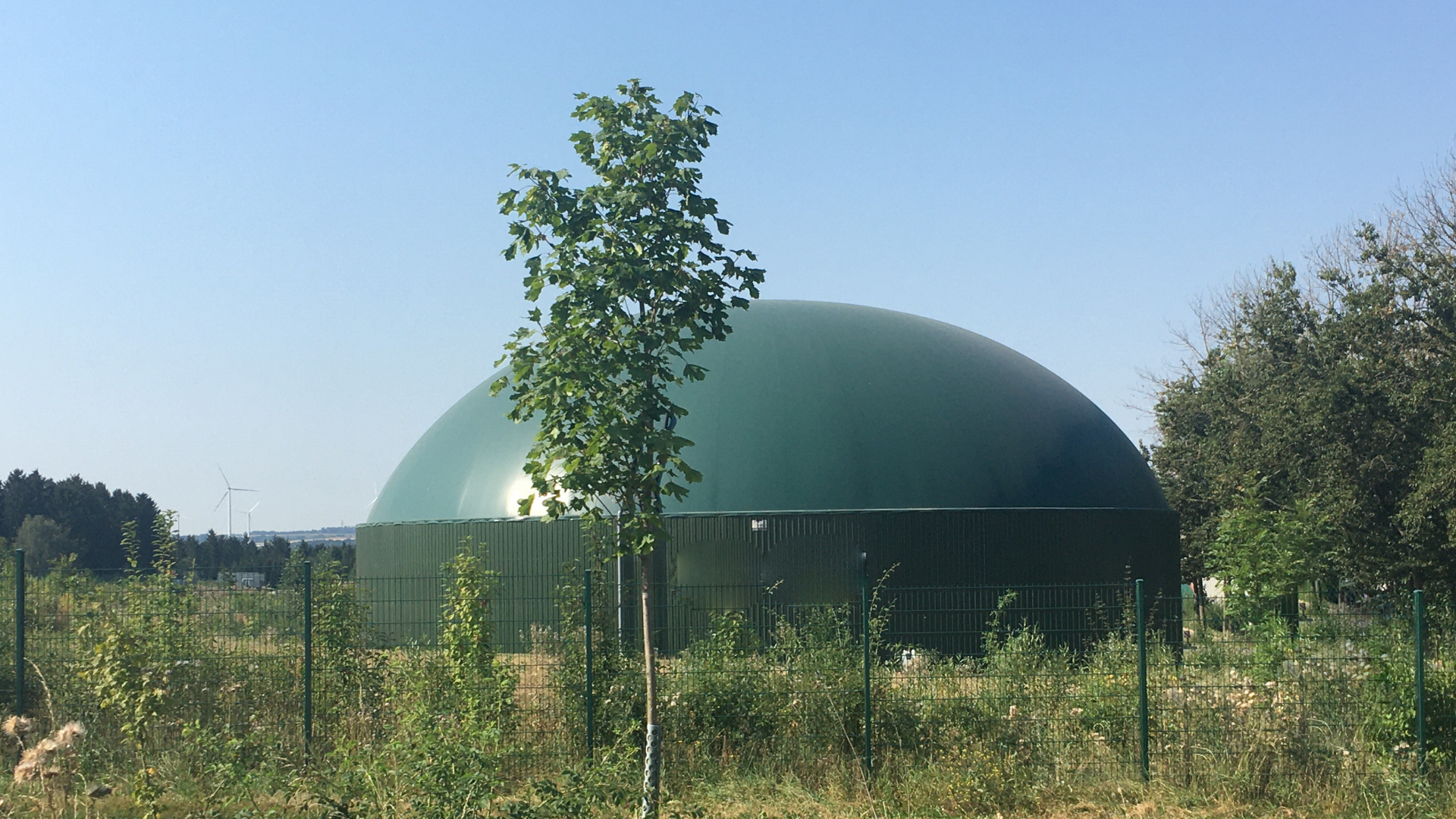
Hydraulic retention time (HRT) is the average time the liquid stays inside the digester; SRT is the time the biomass (the microorganisms) stays. In a conventional CSTR both coincide, but in advanced reactors (UASB, AnMBR) they are decoupled: they retain the biomass much longer than the liquid, which makes it possible to treat large flows in hours. A mesophilic CSTR works with an HRT of 20-40 days; a UASB, of only 4-12 hours with an SRT of 50-100 days. Understanding the difference between HRT and SRT is key to designing and diagnosing a digester.
Retention time is, together with the load, one of the two parameters that define how a digester is operated. And it hides a distinction that is often confused: the time the liquid stays is not the same as the time the biomass stays.
That difference (between HRT and SRT) is what allows a modern reactor to treat in hours what takes a classic digester weeks.
This is the what is of HRT and SRT: what they measure, how they differ, how they are calculated and why they matter. It builds on what anaerobic digestion is.
Definition of HRT and SRT
Hydraulic retention time (HRT) is the average time the liquid phase stays inside the digester. Solids retention time (SRT) is the average time the biomass, that is, the microorganisms, stays.
In a completely mixed reactor with no biomass retention, the liquid and the solids leave together, so HRT and SRT coincide. The distinction only matters (and a lot) when the reactor retains the biomass separately.
Why HRT and SRT can differ: biomass retention
The key lies in biomass retention. Methanogenic archaea grow very slowly: they need a minimum SRT of 10-15 days to avoid being washed out of the reactor. If the HRT drops below that threshold and the biomass leaves with the effluent, the digester is washed out and stops producing.
Advanced reactors solve this by retaining the biomass (in granules, biofilms or with membranes) independently of the liquid. They thus achieve a long SRT with a short HRT: the microbial population stays inside even though the aqueous phase passes through quickly.
Calculating the HRT in conventional reactors (CSTR)
In a CSTR, the HRT is calculated as HRT = V / Q: the working volume of the digester (m³) divided by the feed flow rate (m³/d). The result is days.
In a CSTR with no biomass retention, the SRT equals the HRT: since the biomass is not separated from the liquid, both times are the same. That is why, in this type of reactor, the HRT directly sets the time the consortium has to digest.
Typical operating ranges by substrate and reactor type
The HRT depends on the reactor and the substrate. These are the usual values:
| Reactor | Typical HRT | Typical SRT |
|---|---|---|
| Mesophilic CSTR | 20-40 days | = HRT |
| CSTR (minimum without washout) | ~15 days | ~15 days |
| Plug-flow | 20-30 days | = HRT |
| UASB | 4-12 hours | 50-100 days |
The SRT/HRT ratio goes from roughly 1 in a CSTR (coupled) to 100-1,000 in a UASB (decoupled). Each of the types of digesters exploits this principle in a different way.
Short HRT: the risk of biomass washout
Lowering the HRT increases treatment capacity, but it has a limit. Below the minimum SRT of the methanogens (10-15 days in a CSTR), the biomass is washed out faster than it can reproduce.
The result is a drop in methane production and, in extreme cases, the collapse of the process. The HRT goes hand in hand with the organic loading rate: for the same substrate, raising the load usually shortens the HRT, so both limits are reached at the same time.
Long HRT: economic and operational effects
A long HRT gives a wider stability margin: the substrate is fully digested and the system better tolerates variations in diet or temperature. But it is usually expensive from an economic and operational point of view.
A longer HRT requires larger reactors for the same flow, which drives up CAPEX. Design seeks the minimum HRT that guarantees complete, stable digestion without overpaying in construction volume. Defining that design HRT is one of the decisions validated in a biogas pilot before scaling up.
Reactors that decouple HRT and SRT: UASB and AnMBR
UASB and AnMBR reactors break the link between HRT and SRT. The UASB retains the biomass in dense granules that do not leave with the effluent; the AnMBR, with a membrane that lets no microorganism escape.
They thus treat large flows in hours (short HRT) while keeping the whole population inside (long SRT). This is what allows them to work with much smaller volumes than a CSTR for the same flow, in exchange for greater complexity and operating cost.
Frequently asked questions about HRT and SRT
What is the HRT in a biogas plant?
The HRT (hydraulic retention time) is the average time the liquid phase stays inside the digester. It is calculated by dividing the working volume of the reactor by the daily feed flow, and is expressed in days (or hours, in very fast reactors). It is one of the basic design parameters: it determines how much time the consortium has to digest the substrate.
What is the difference between HRT and SRT?
The HRT is the time the liquid stays in the reactor; the SRT (solids retention time) is the time the biomass, that is, the microorganisms, stays. In a conventional CSTR, liquid and biomass leave together and both coincide. In reactors that retain the biomass (UASB, AnMBR), the SRT can be much longer than the HRT: the microbial population stays inside even though the liquid passes through quickly.
What is the optimal HRT for a mesophilic digester?
In a mesophilic CSTR digester, the usual HRT is 20 to 40 days. The practical minimum without risk of biomass washout is around 15 days, because methanogenic archaea need an SRT of at least 10-15 days to maintain themselves. The optimal value depends on the substrate: fibrous substrates need more time; soluble ones, less.
Why do UASB reactors have a much shorter HRT than CSTRs?
Because they decouple the HRT from the SRT. A UASB retains the biomass as dense granules that do not leave with the effluent, so it can pass the wastewater through in a few hours (short HRT) while keeping the whole microbial population inside (SRT of 50-100 days). A CSTR, since it does not retain the biomass, needs a long HRT to avoid washing out the biomass.
Smallops and retention time sizing
A poorly sized HRT means either an oversized reactor (immobilised money) or a digester on the edge of biomass washout. At Smallops we verify the real HRT and SRT of your plant with an Operational Excellence Diagnosis.
Is your digester working with the right HRT?
Request a Smallops Operational Excellence Diagnosis: we check the real retention time, the risk of biomass washout and the margin to optimise flow and production.
References and standards
Veeken, A. & Hamelers, B. (1999). Effect of temperature on hydrolysis rates of selected biowaste components. Bioresource Technology, 69 (3), 249-254.
Rincón, B. et al. (2008). Influence of organic loading rate and hydraulic retention time on the performance of anaerobic digestion. Bioresource Technology, 99 (16), 7995-8005.
Henze, M. et al. (2008). Biological Wastewater Treatment: Principles, Modelling and Design. IWA Publishing.
Speece, R.E. (1996). Anaerobic Biotechnology for Industrial Wastewaters. Archae Press.