
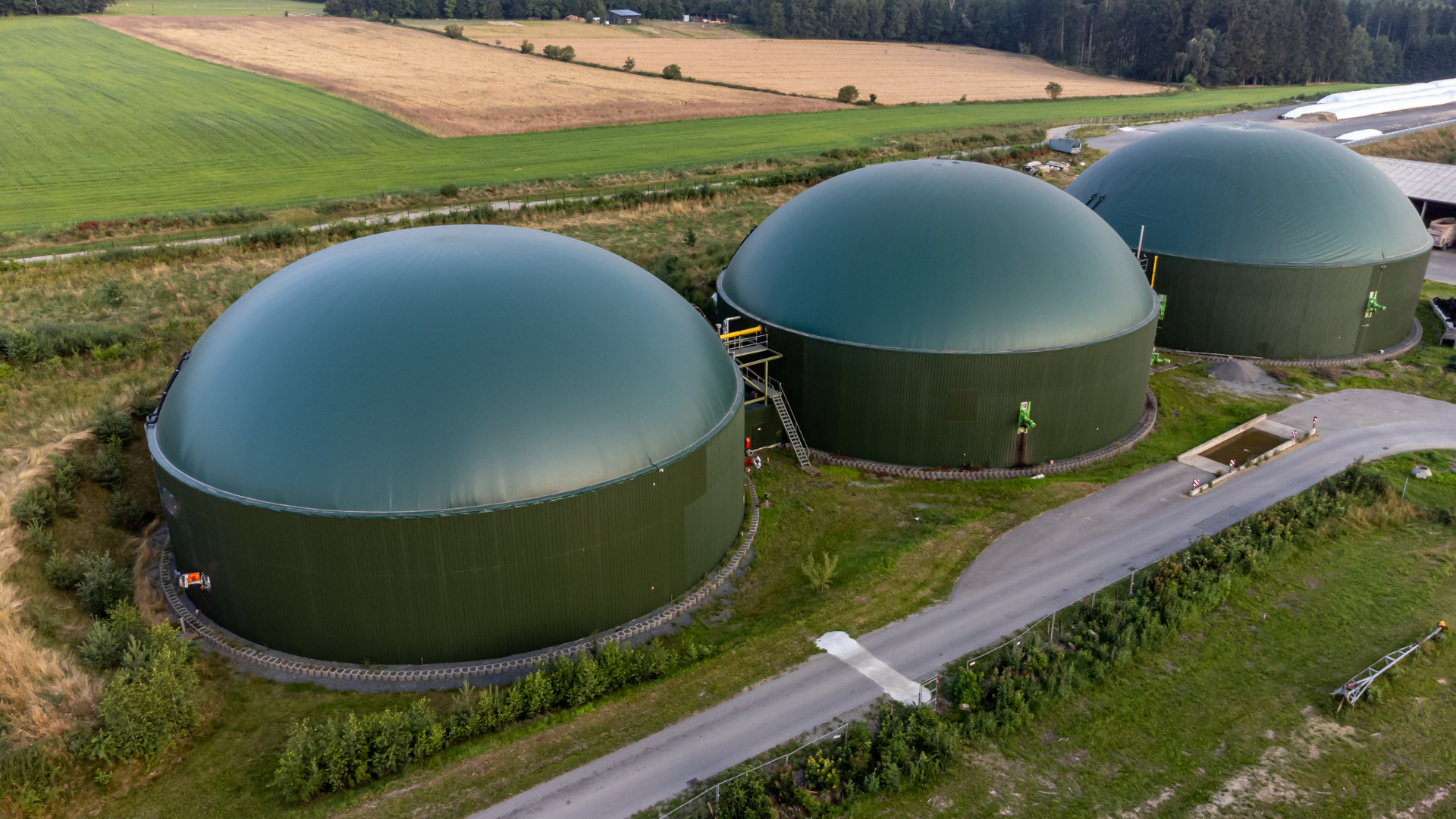
Mixing is the operational variable that keeps the digester homogeneous: without adequate mixing, crusts, sediments and temperature gradients appear that cut production by 5-15 %. There are three families of systems (mechanical, hydraulic and gas-lift) and none is the best in the abstract: it depends on the substrate, the geometry of the reactor and the energy cost (mixing consumes 1-5 % of the electricity produced). In most plants, a well-adjusted intermittent regime (about 15 minutes every 1-2 hours) mixes enough and saves energy.
Mixing is the great forgotten variable of the digester. It does not show up in the analyses, it has no probe measuring it continuously and yet it is behind a good share of the operational problems: crusts, sediments, dead zones and thermal shocks.
It is also a silent consumer: mixers work thousands of hours a year and their electricity bill is felt. Overmixing costs money; undermixing costs production.
This article reviews the types of mixing, how mixing efficiency is assessed, the continuous vs intermittent debate and the signs that reveal poor mixing.
Why mixing matters in an anaerobic digester
Mixing fulfils four functions at once: it puts the fresh substrate in contact with the active biomass (mass transfer), homogenises the temperature avoiding gradients (see temperature control), helps release the biogas trapped in the liquid and prevents phase separation.
When mixing fails, the digester stratifies, that is, the floating material rises and forms a crust, the heavy material falls and forms sediment, and the working volume of the reactor shrinks without anyone seeing it. Poor mixing can cut production by 5-15 % before giving any obvious symptom.
Types of mixing: mechanical, hydraulic, gas-lift
Mixing systems fall into three families:
| Type | How it works | Strengths | Limits |
|---|---|---|---|
| Mechanical (propellers, paddles) | Submerged or shaft mixers that move the digestate directly | Energetic, directable mixing; the standard in agricultural digesters | Moving parts inside the reactor; wear and maintenance |
| Hydraulic (recirculation) | External pumps that recirculate the digestate and reinject it | Equipment accessible outside the reactor; combines with heat exchangers | Less effective against crusts; pumping consumption |
| Gas-lift (pneumatic) | Injection of the plant\u2019s own compressed biogas through the base of the digester | No moving parts inside; gentle, homogeneous mixing | Little capacity against crusts and sand; a compressor to maintain |
The choice depends on the substrate (fibrous or not, with or without sand), the geometry of the reactor and the type of digester. There is no universal winner; it simply comes down to choosing the type of mixing for each particular case.
Calculating mixing efficiency
The classic design reference is the specific installed power (W per m³ of digester) and the surface velocity the system achieves in the critical zones. To avoid crust formation, the literature places the minimum surface velocity at around 0.3-0.5 m/s.
In operation, real efficiency is assessed indirectly: temperature uniformity between probes at different heights, stability of the digestate composition at different sampling points and absence of dead zones (nowadays studied with CFD models and tracers). A well-mixed digester gives the same readings wherever you measure.
Signs of poor mixing: crusts, sediments, gradients
The three classic symptoms are visible if you know where to look:
- Floating crusts: a layer of fibres and floating material on the surface that grows until it hardens. It is the most frequent symptom with fibrous substrates (detailed in the post on floating crusts).
- Sediments and sand: accumulation at the bottom that steals working volume year after year (see digester sediments).
- Temperature gradients: sustained differences between probes at different heights reveal stratification and insufficient mixing.
Added to these are indirect signals: localised foaming, gas peaks when the mixer starts up since the biogas was trapped, and heterogeneous digestate between purge points.
Optimal regime: continuous vs intermittent
Continuous mixing guarantees maximum homogeneity, but it rarely pays off; rather, it consumes more, wears more, and there is evidence that overly energetic mixing can even break up the microbial aggregates that sustain the transfer between bacteria and archaea.
That is why most plants work in an intermittent regime: cycles of the order of 15 minutes every 1-2 hours, reinforced around the feedings. The fine tuning (duration, frequency and speed if the drive allows it) is done by watching the symptoms of the previous section.
Energy consumption and optimisation
Mixing typically consumes 1-5 % of the electricity production of the plant. It seems little, but it is a constant consumption over thousands of hours a year; in fact, going from a poorly adjusted continuous regime to an optimised intermittent one can save tens of MWh per year without losing production.
The optimisation levers are, in order of cost: adjusting cycles and schedules (free), installing variable-frequency drives, repositioning or replacing mixers and, as a last resort, changing the system. A complete change of mixing system costs in the order of €30,000 to €120,000 depending on the size of the digester, so before getting there it is worth exhausting the cheap levers.
Diagnosing mixing failures
The diagnosis starts with what is cheap: comparing temperatures between probes, reviewing the electricity consumption of each mixer (a falling consumption reveals a worn or broken propeller; a rising one, tangled fibres) and observing the surface of the digester with the mixer running.
If the clues point to dead zones, the next step is sampling the digestate at different heights and, in serious cases, measuring the real working volume (by tracers or inspection). Many «small» digesters are actually large digesters half full of sediment.
Frequently asked questions about digester mixing
What is the best mixing system for a digester?
There is no universally better mixing system. The choice depends mainly on the characteristics of the substrate, the design and volume of the digester, the presence of solids or fibres and the installation and maintenance costs.
- Mechanical mixing: one of the most widely used systems, especially in agricultural digesters. Using mixers or propellers it delivers effective mixing and can adapt to different types of substrate. However, it requires mechanical elements inside the digester, which can suffer wear or need maintenance.
- Hydraulic mixing: it uses the recirculation of the digestate itself to promote mixing. One of its main advantages is that the pumping equipment can be located outside the reactor, making access for maintenance and repair easier. However, its effectiveness depends on the characteristics of the digestate and the design of the recirculation system.
- Gas-lift or biogas mixing: it uses the biogas generated in the process itself to drive the circulation of the digester contents. As it needs no moving mechanical elements inside, it can reduce certain maintenance problems. However, it can be less effective when there are crusts, sand or a high solids concentration, so it is not always the most suitable option.
In short, the best mixing system is the one that adapts to the specific characteristics of the digester and the substrate to be treated. Before choosing it, factors such as viscosity, solids content, the presence of fibres or sand, the tendency to form crusts, the reactor volume, energy consumption and maintenance needs must be considered.
How do I know if my digester is poorly mixed?
The three classic signs are floating crusts on the surface, sediments growing at the bottom and temperature gradients between probes at different heights. In addition, some indirect signals can be biogas peaks when the mixer starts up, the appearance of localised foaming and heterogeneous digestate depending on the sampling point. Poor mixing can be costing 5-15 % of production without clear symptoms.
How much does the mixing system consume?
Typically between 1 and 5 % of the electricity the plant produces. It is a constant consumption over thousands of hours a year, so its optimisation (well-adjusted intermittent cycles, variable-frequency drives, mixers in good condition) is among the efficiency measures with the best return at a biogas plant.
Is continuous or intermittent mixing better?
For most plants, intermittent, consisting of cycles of the order of 15 minutes every 1-2 hours which maintain homogeneity with a fraction of the consumption. Continuous mixing is only justified in specific cases such as substrates very prone to stratifying. Moreover, overly energetic mixing can harm the microbial aggregates. The key is to adjust the regime while watching crusts, sediments and gradients.
Smallops and mixing diagnosis
Poorly adjusted mixing is paid for twice: in electricity consumed and in production lost. At Smallops we assess the real homogeneity of your digester (temperatures, samplings, mixing consumption) with an Operational Excellence Diagnosis.
Is your digester well mixed?
Request a Smallops Operational Excellence Diagnosis: we check the real homogeneity of the reactor, the state and consumption of your mixers and how much working volume the sediment is stealing from you.
References and standards
Wu, B. (2014). CFD analysis of mixing in anaerobic digesters. Water Research, 65, 109-128.
Karim, K. et al. (2005). Anaerobic digestion of animal waste: effect of mixing. Bioresource Technology, 96 (14), 1607-1612.
Lindmark, J. et al. (2014). Effects of mixing on the result of anaerobic digestion. Renewable and Sustainable Energy Reviews, 40, 1030-1047.
Singh, B. et al. (2020). Mixing strategy in anaerobic digesters. Bioresource Technology, 311, 123423.