
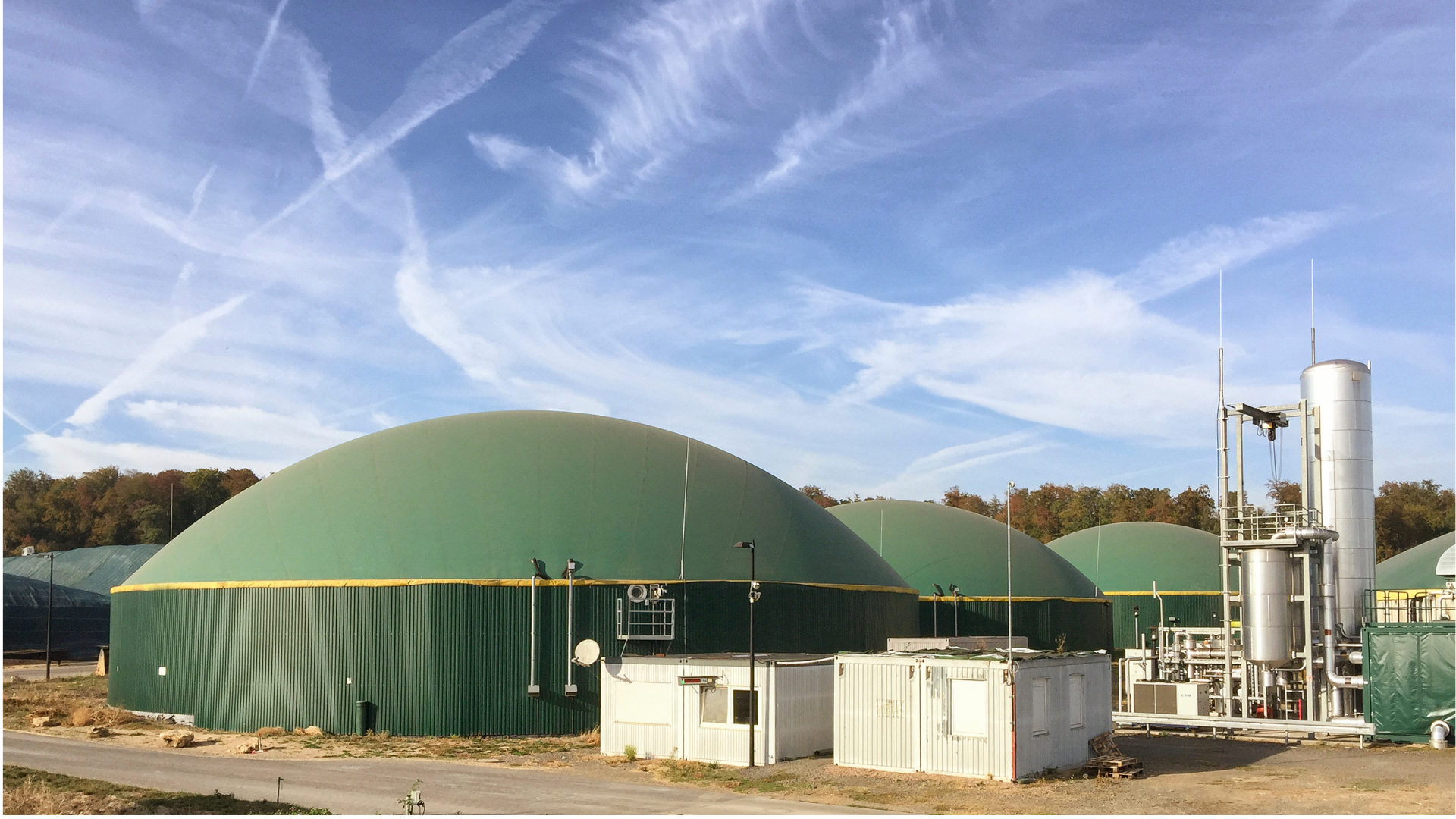
Biogas cogeneration engines between 1 and 50 MW thermal are subject to Royal Decree 1042/2017, which transposes the European Medium Combustion Plant Directive. Their limits are 190 mg/Nm³ of NOx and 40 mg/Nm³ of SO2 in new engines (60 mg/Nm³ of SO2 in existing ones), referred to 15% O2; CO has no national limit but must be measured at every check, and the regional authorisation may add stricter limits. Exceeding the limit values is a serious infringement (fines of €20,001 to €200,000), which can become very serious. The good news: most non-compliances are avoided with well-run desulphurisation and a well-tuned engine.
The stack or engine exhaust is one of the points of the plant where regulation is tightest and where there is least room for improvisation: the limits are numerical, the measurements are periodic and non-compliances are recorded.
The usual confusion comes from the fact that there is no single rule: the specific values that apply to each plant depend on its capacity, its age and what its environmental authorisation sets.
This article sets out the reference limits for biogas engines, when and how measurements must be made, what happens in case of non-compliance and which technologies exist to comply. The complete map of the legal framework is in the post on biogas regulation in Spain.
Regulatory framework: Royal Decree 1042/2017 (MCP Directive) and emissions authorisation
The central piece is Royal Decree 1042/2017, which transposes Directive (EU) 2015/2193 on medium combustion plants: it applies to installations of 1 MW or more and less than 50 MW thermal and sets the limit values in its annex II. Added to this is Royal Decree 100/2011, which catalogues activities potentially polluting the atmosphere: biogas production is included (code 09 10 06 00, group B), so the plant usually needs an emissions authorisation from the autonomous community, whatever the size of the engine.
Royal Decree 815/2013 (industrial emissions regulation) only comes into play if the plant is subject to integrated environmental authorisation, for example when anaerobic digestion treats more than 100 tonnes of waste a day (Royal Legislative Decree 1/2016, annex 1). Even then, the reference limits for the engine are still those of Royal Decree 1042/2017, although the integrated environmental authorisation may set them stricter.
In practice, the operational reference for each plant is its environmental authorisation: that is where the limit values, the sampling points and the measurement schedule required by the administration are specified.
Emission limit values: NOx, SO2, particulates and CO
For a biogas engine between 1 and 50 MW thermal, the values of annex II of Royal Decree 1042/2017 are these:
| Pollutant | New engine (from 20 Dec 2018) | Existing engine | Remarks |
|---|---|---|---|
| NOx | 190 mg/Nm³ | 190 mg/Nm³ | The limit that most conditions engine tuning |
| SO2 | 40 mg/Nm³ | 60 mg/Nm³ | Depends directly on the H2S in the biogas |
| Particulates | No national limit | No national limit | Not very critical in well-maintained gas engines |
| CO | No national limit; measurement mandatory | No national limit; measurement mandatory | Sensitive to the mixture and the engine condition |
Values are expressed in mg/Nm³ of dry gas (273.15 K and 101.3 kPa) referred to 15% O2 for engines. In existing dual-fuel engines (with diesel pilot injection) running in gas mode, the NOx limit is 380 mg/Nm³. Non-methane volatile organic compounds (NMVOC) have no limit in Royal Decree 1042/2017. Note: the exact figure applicable to your plant is the one in your authorisation, because the autonomous community may set stricter or additional limits. A nearby example is the integrated environmental authorisation that the Regional Government of Extremadura granted in 2011 to a 49 MW electrical energy-crop biogas plant project in Navalmoral de la Mata (Cáceres). It set 200 mg/Nm³ of NOx, 35 mg/Nm³ of SO2, 300 mg/Nm³ of CO and 5 mg/Nm³ of particulates referred to 3% O2, which at 15% O2 are equivalent to about 67, 12, 100 and 1.7 mg/Nm³: well below the national limits. It also required continuous measurement of NOx, SO2 and particulates.
Application by rated thermal input
The rated thermal input of the engine determines the applicable regime: installations of 1 to 50 MW thermal fall under the medium combustion plant regime (mandatory registration, limits and periodic measurements). New ones comply from commissioning; existing ones (commissioned before 20 December 2018), from 1 January 2025 if they exceed 5 MW and from 1 January 2030 if they are between 1 and 5 MW.
Below 1 MW thermal Royal Decree 1042/2017 does not apply: the regional authorisation and the catalogue of Royal Decree 100/2011 govern. Large plants or those subject to integrated environmental authorisation also operate with specific conditions in that authorisation.
Mandatory measurement methods and frequency
Measurements are carried out by an inspection body, at the sampling points of the stack and with the reference methods for each pollutant. The minimum frequency is set by Royal Decree 1042/2017: at least every three years for installations of 1 to 20 MW thermal and every year above 20 MW. The first measurement must be made within four months of the authorisation or registration (or of commissioning, if later), and the autonomous community may require more.
Between 1 and 50 MW thermal, national legislation does not require continuous measurement, although the autonomous community may require it in the authorisation; the general obligation of continuous measurement applies to combustion installations of 100 MW or more.
As important as measuring is recording: measurement reports, operating hours, incidents and consumption must be kept available to the administration. In an inspection, the documentary record weighs as much as the latest measurement.
Control technologies: SCR, catalytic oxidation, advanced desulphurisation
The first emissions control is not at the stack but in the gas entering the engine: the SO2 emitted is proportional to the H2S in the biogas, so well-run biogas desulphurisation solves that front at the root (and protects the engine at the same time). As an order of magnitude, with biogas at 60% CH4, the 40 mg/Nm³ SO2 limit is equivalent to about 270 ppm of H2S in the gas entering the engine, and the 60 mg/Nm³ limit to about 400 ppm. Gas quality is monitored as part of the biogas composition.
For NOx, the first lever is engine tuning (lean mixture, ignition timing): it is usually enough to meet 190 mg/Nm³. If it is not, or if the authorisation is stricter, after-treatments are used: SCR (selective catalytic reduction with urea) for NOx and catalytic oxidation for CO and organic compounds. They are effective, but they add CAPEX, reagent consumption and a catalyst sensitive to biogas contaminants; another reason to keep the gas clean upstream.
Penalties for non-compliance
The penalty regime is in Law 34/2007 on air quality, to which Royal Decree 1042/2017 refers. Exceeding the limit values is a serious infringement, with fines of €20,001 to €200,000, and it can become very serious (€200,001 to €2,000,000) if it seriously endangers health or the environment, in addition to possible closures or suspension of the authorisation.
In practice, the typical case does not start with a catastrophe but with an oversight: a periodic measurement not carried out or a limit exceeded without a corrective plan. It is one of the cheapest regulatory risks to prevent.
Periodic review and environmental authorisation
The environmental authorisation is not a one-off procedure: it is reviewed periodically and can tighten limits when incorporating best available techniques. Every relevant modification of the plant (more capacity, new engine, change of substrates) may require it to be updated.
The operational recommendation: treat the environmental calendar (measurements, reports, renewals) as you treat engine maintenance, with an owner and dates. And use each periodic measurement as a free diagnosis of engine tuning: a NOx that rises for no reason says something about combustion. For plants planning to leave cogeneration, the jump to biomethane EN 16723 moves much of this chapter to the quality of the injected gas, although the digester boiler and the upgrading tail gas remain subject to what their authorisation sets.
Frequently asked questions about emissions in biogas cogeneration
What emissions does a biogas engine produce?
The main ones are nitrogen oxides (NOx, produced by high-temperature combustion), carbon monoxide (CO, from incomplete combustion), sulphur dioxide (SO2, proportional to the H2S in the biogas), non-methane volatile organic compounds (NMVOC) and, to a lesser extent, particulates. Royal Decree 1042/2017 limits NOx and SO2 and requires CO to be measured at every check; the rest depends on what the regional authorisation sets.
What are the legal NOx limits in biogas cogeneration?
For biogas engines between 1 and 50 MW thermal, Royal Decree 1042/2017 sets 190 mg/Nm³ of NOx (referred to 15% O2), for both new and existing engines; existing ones must comply from 1 January 2025 if they exceed 5 MW and from 1 January 2030 if they are between 1 and 5 MW. The exact value applicable to each plant is set by its authorisation, which may be stricter.
When are emission measurements mandatory?
Under Royal Decree 1042/2017, at least every three years in installations of 1 to 20 MW thermal and every year above 20 MW, with the first measurement within four months of the authorisation or registration (or of commissioning, if later). They are carried out by an inspection body, and the autonomous community may require more frequent or even continuous measurements.
Which technologies reduce NOx in biogas engines?
In order of cost: fine engine tuning (lean-burn combustion, ignition timing), which is usually enough to meet the 190 mg/Nm³ reference; and, if that is not enough, selective catalytic reduction (SCR) with urea as an after-treatment. For CO and organic compounds, catalytic oxidation is used. All catalysts benefit from clean biogas: desulphurisation and gas drying extend their service life.
Smallops and emissions compliance
Behind a NOx or SO2 value out of limits there is almost always a process problem: dirty gas, poorly tuned combustion or insufficient desulphurisation. At Smallops we connect the quality of your biogas with your engine emissions within an Operational Excellence Diagnosis.
Would you pass an emissions measurement tomorrow?
Request a Smallops Operational Excellence Diagnosis: we review the quality of your biogas, the tuning of your engine and your measurement calendar so that the next inspection is a formality.
References and standards
Royal Decree 1042/2017, of 22 December, on the limitation of emissions into the atmosphere of certain pollutants from medium combustion plants. boe.es
Directive (EU) 2015/2193 on the limitation of emissions from medium combustion plants. eur-lex.europa.eu
Law 34/2007, of 15 November, on air quality and atmosphere protection. boe.es
Royal Decree 100/2011, catalogue of activities potentially polluting the atmosphere. boe.es
Royal Decree 815/2013, of 18 October, approving the Industrial Emissions Regulation. boe.es
Royal Legislative Decree 1/2016, consolidated text of the Law on integrated pollution prevention and control. boe.es