
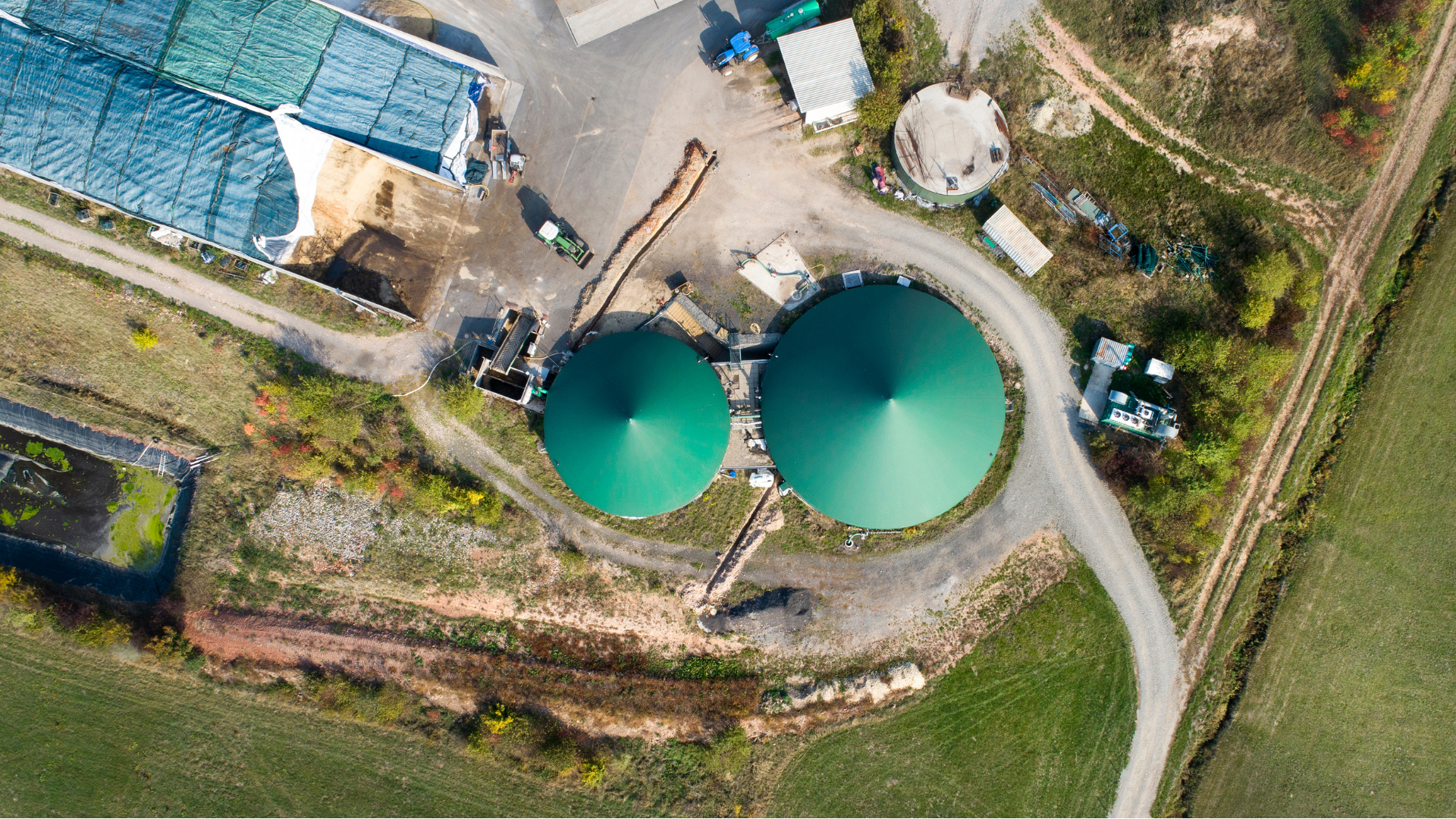
Biogas is not a new technology: the first documented uses date from the late 19th century, in a leper colony in Bombay and at the Exeter wastewater works. Since then it has gone from solving urban sanitation (the large wastewater plants of the 20th century) to becoming a piece of the energy transition, driven by the 1970s oil crisis and German leadership. Today Europe adds up around 14 GW of biogas electricity and biomethane is growing strongly. This article reviews that history (from the 19th century to today’s biorefinery) and the state of biogas in Spain.
The history of biogas is much longer than it seems. Although today it is associated with the energy transition, the use of the gas from anaerobic decomposition is documented as early as the 19th century.
Understanding that evolution helps to place the sector: biogas was born as a sanitation solution, grew as a crisis energy and today is consolidating as a piece of the circular economy and decarbonisation.
This is the journey, from the first rural digester to industrial plants and grid biomethane, with special attention to the case of Spain. It all stems from the same process: anaerobic digestion.
The origins: rural digesters in the 19th century
One of the first documented uses of biogas is attributed to a leper colony in Bombay (India), in the late 19th century, where the gas from the fermentation of waste was collected for lighting. The idea (capturing the gas released by organic matter as it rots without air) was rudimentary but effective.
At that time biogas was a local curiosity: small home or rural digesters, without process control, using the gas for lamps or cooking.
The era of the large WWTPs (1900-1970)
The first serious leap came with urban sanitation. In 1895, in Exeter (United Kingdom), Donald Cameron set up a septic tank to treat the city’s wastewater and used part of the gas for heating and lighting the works itself.
During the 20th century, wastewater treatment plants (WWTPs) incorporated digesters to stabilise the sludge and, in passing, generate energy. Biogas stopped being a curiosity and became a useful by-product of water treatment.
The 1970s energy crisis and German agricultural biogas
The 1970s oil crisis changed the view of biogas: it was no longer just sanitation, but an energy source of its own. Research and the first agricultural installations took off.
Germany took the lead in the 1990s with a framework of incentives for renewable electricity (the 1991 feed-in law and, above all, the EEG of 2000). It was the seed of a spectacular growth in the following decades.
Industrial consolidation (1990-2010): large-scale co-digestion
Between 1990 and 2010 biogas became industrialised. Germany went from around 140 plants in the early 1990s to more than 9,400 at the end of 2018, driven by regulated tariffs and by co-digestion: mixing slurry, energy crops and waste to maximise production.
Digesters grew in size and control. Large-scale co-digestion turned biogas into a mature industry, not an experiment.
The 21st century: from biogas to biorefinery
In the 21st century the focus broadens. Biogas is no longer burned only to make electricity: it is purified to biomethane to inject it into the natural gas grid or use it as fuel, and the digestate is valorised as fertiliser.
The modern plant is thought of as a biorefinery: energy, fertiliser and, increasingly, CO₂ capture. Gas quality gains weight (see biomethane EN 16723).
Biogas in Spain: timeline and current state
Spain arrived later and with less intensity than central Europe. Development relied first on WWTPs and some agro-industrial plants, with an irregular incentive framework.
In 2024 Spain had around 270 biogas plants and 14 biomethane plants in operation (EBA), a modest figure compared with the country’s potential (large livestock herd and a lot of agri-food industry). The push for biomethane and the new regulations point to accelerated growth.
Where the sector is heading: biomethane, integral valorisation and decarbonisation
The trends are clear. Europe already adds up around 14 GW of biogas electricity installed (IRENA, 2024) and world biomethane production was around 80 TWh in 2023 (IEA) and is growing fast.
The future runs on three axes: biomethane to decarbonise grid gas, integral valorisation (energy + fertiliser + CO₂) and operational efficiency so that each plant performs at its maximum. Biogas is ceasing to be a niche energy to become a decarbonisation tool.
Frequently asked questions about the history of biogas
When was biogas discovered?
The use of biogas is documented as early as the 19th century. Among the first known installations are the Exeter septic tank (United Kingdom), which in 1895 used the gas for heating and lighting the works itself, and a leper colony in Bombay (India) that in the late 19th century collected the gas from the fermentation of waste for lighting. The phenomenon of anaerobic fermentation, however, had been known long before.
Why is Germany the world leader in biogas?
Because of a set of early and sustained incentives for renewable electricity, which made it profitable to build agricultural co-digestion plants. Germany went from around 140 plants in the early 1990s to more than 9,400 at the end of 2018. That regulatory push, combined with a strong agricultural industry, made it the world reference for the sector.
What is the state of biogas in Spain?
Spain had around 270 biogas plants and 14 biomethane plants in operation in 2024 (EBA), a modest figure for its potential (large livestock herd and agri-food industry). The sector grew relying on WWTPs and agro-industrial plants, with irregular incentives. The current push for biomethane and the new regulations point to significant growth in the coming years. In addition, in terms of potential, Spain is one of the European countries with the greatest untapped capacity for waste convertible into biogas.
What is biomethane and when did it appear?
Biomethane is biogas purified to a quality equivalent to natural gas, suitable to inject into the grid or use as fuel. It began to spread in the 21st century, when upgrading technologies (CO₂ separation) matured and regulatory frameworks for grid injection appeared. World production was around 80 TWh in 2023 (IEA) and is growing rapidly.
Smallops and biogas efficiency
Knowing where biogas comes from helps to understand where it is going: more efficient and better-operated plants. At Smallops we help each plant perform at its maximum with an Operational Excellence Diagnosis.
Is your plant performing at the sector’s level?
Request a Smallops Operational Excellence Diagnosis: we measure your process across 14 variables and tell you how to improve production and stability.
References and standards
Bond, T. & Templeton, M.R. (2011). History and future of domestic biogas plants in the developing world. Energy for Sustainable Development, 15 (4), 347-354. → doi.org/10.1016/j.esd.2011.09.003
Lijó, L. et al. (2017). The environmental effect of substituting energy crops for food waste as feedstock for biogas production. Energy, 137, 1130-1143. → doi.org/10.1016/j.energy.2017.04.137
European Biogas Association (2025). EBA Statistical Report 2025. → europeanbiogas.eu
MITECO (2022). Hoja de Ruta del Biogás (Biogas Roadmap). → miteco.gob.es
IRENA (2025). Renewable Capacity Statistics 2025. → irena.org
IEA (2025). Outlook for Biogas and Biomethane. → iea.org