
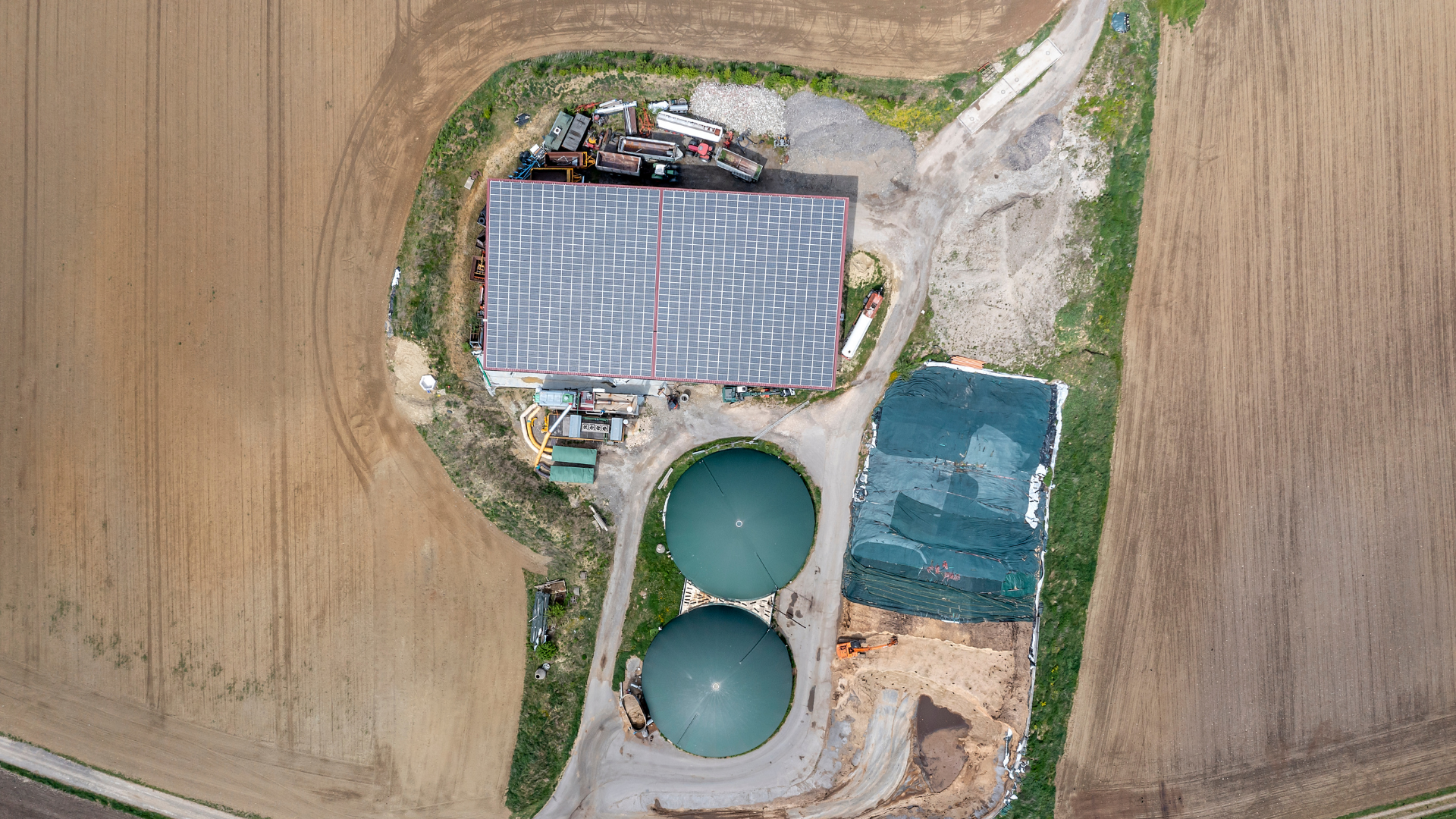
There is no universal digester: the right configuration depends on the substrate, the scale and the objective. CSTR reactors (fully mixed) are the standard for agro-industrial and livestock waste; UASB reactors treat industrial wastewater at high speed; plug-flow reactors suit very solid substrates; covered lagoons are the low-cost, high-volume option; two-stage configurations separate phases for difficult substrates; and AnMBRs are the technological frontier. This article compares each type (principle, operating ranges, advantages and limits) and explains how to choose.
Choosing the type of anaerobic digester is one of the most decisive decisions in a biogas project. It conditions the investment, the performance and which substrates can be treated.
There is no digester that is «best» in the abstract: there is the right one for each combination of substrate, scale and objective. A reactor designed for dilute wastewater is no use for thick slurry, and vice versa.
This is the comparison of the most widespread configurations, with their operating principle, their operating ranges and the cases where each one has become established. They all share the biological basis of what anaerobic digestion is; what changes is how it is applied.
Why the digester configuration matters
The biological stages are the same in every digester: the four phases and a similar microbial consortium. What changes completely is the engineering (how it is mixed, how substrate enters and leaves, how long it stays inside), and that determines the performance of each phase and of the whole.
Two parameters govern the design: the hydraulic retention time (HRT, how long the liquid stays in the reactor) and the organic loading rate (OLR, how much material is fed per volume and day). Each configuration balances them differently.
CSTR reactors (Continuous Stirred Tank Reactor): the industrial standard
The CSTR is a fully mixed tank with continuous stirring. Substrate enters, is mixed homogeneously and leaves by overflow. It is the most common configuration in agro-industrial and livestock plants for its robustness and simplicity.
Typical ranges: HRT of 20-40 days and OLR of 2-6 kg VS/m³·day.
Advantages: tolerates varied substrates, homogeneous mixing (no dead zones if stirring is good) and very mature technology.
Limits: large volume, stirring energy consumption, and HRT and solids retention time (SRT) are coupled.
UASB reactors (Upflow Anaerobic Sludge Blanket): wastewater
In the UASB, wastewater enters from the bottom and rises through a blanket of highly active granular sludge. The biomass is retained in dense granules, which allows large flows to be treated in very little time.
Typical ranges: HRT of just 4-12 hours and loads of 5-15 kg COD/m³·day.
Advantages: extremely high treatment speed, compact reactor and ideal for soluble industrial wastewater (sugar, brewing, paper mills).
Limits: not suitable for substrates with many solids or fats, and requires forming and maintaining the granular sludge.
Plug-flow reactors: high solids content
The plug-flow is an elongated (horizontal) reactor in which the substrate advances as a «plug» from one end to the other with almost no longitudinal mixing. It suits thick substrates.
Typical ranges: inlet total solids (TS) of 10-15 % and HRT of 20-30 days.
Advantages: handles high solids without dilution, little or no stirring, and the phases separate naturally along the reactor.
Limits: less flexible to diet changes and can form crusts if the substrate is very fibrous.
Covered anaerobic lagoons: low cost, high volume
A lined pond covered with a membrane that captures the biogas. It is the lowest-investment option, common on large livestock farms with a lot of slurry.
Typical ranges: long HRT of 30-60 days and low OLR (<2 kg VS/m³·day).
Advantages: minimum CAPEX, large storage capacity and simple operation.
Limits: low productivity per volume, sensitive to ambient temperature and hard to control finely.
Two-stage configurations: separating hydrolysis and methanogenesis
In a two-stage system, hydrolysis and acidogenesis occur in a first reactor and methanogenesis in a second. This way each microbial group works in its optimal conditions.
When it pays off: difficult or highly variable substrates, where methanogenesis needs protection from acid peaks. It improves stability and, sometimes, performance.
Limits: more complex and expensive (two reactors, more control). It does not pay off for stable, simple diets.
Membrane reactors (AnMBR): the technological frontier
The AnMBR (Anaerobic Membrane Bioreactor) combines anaerobic digestion with a filtration membrane that retains all the biomass. This decouples the solids retention time (SRT) from the HRT: you can have a very short HRT while keeping the entire microbial population inside.
Typical ranges: HRT of 1-3 days with a much larger SRT.
Advantages: very clarified effluent, compact reactor and maximum biomass retention.
Limits: high CAPEX and OPEX (the membrane fouls and must be cleaned); it is the frontier, still not widespread at large scale.
How to choose the digester type by substrate and scale
There is no single answer, but there is a clear logic. As an indicative summary:
| Configuration | Ideal substrate | Typical HRT | Relative CAPEX |
|---|---|---|---|
| Covered lagoon | Dilute slurry, high volume | 30-60 days | Very low |
| CSTR | Agro-industrial, livestock, co-digestion | 20-40 days | Medium |
| Plug-flow | High solids (10-15 % TS) | 20-30 days | Medium-high |
| UASB | Soluble wastewater | 4-12 hours | High |
| AnMBR | Demanding flows, clean effluent | 1-3 days | Very high |
The CAPEX order, from lowest to highest, is usually: lagoon < CSTR < plug-flow < UASB < AnMBR. But cost is not the only criterion: a cheap lagoon with low productivity can end up more expensive per kWh than a well-sized CSTR.
Frequently asked questions about types of anaerobic digesters
Which type of digester is best for slurry?
For livestock slurry, the two most common options are the covered anaerobic lagoon (when there is a lot of volume and low cost is the priority) and the fully mixed CSTR reactor (when more productivity and control are sought, especially in co-digestion). Slurry is dilute and fluid, so it fits well with both; the choice depends on the scale, the budget and whether it will be co-digested with other substrates. You can see the biogas from slurry case in detail.
When is a UASB reactor used?
The UASB is used to treat soluble industrial wastewater with a low solids load: effluents from sugar mills, breweries, distilleries, paper mills or the food industry. Its great advantage is speed: it treats high COD loads in hours thanks to the granular sludge. It is not suitable for thick slurry, primary WWTP sludge or substrates with a lot of fats.
What is a two-stage digester and when does it pay off?
It is a configuration in which hydrolysis/acidogenesis and methanogenesis are separated into two different reactors, so that each group of microorganisms works in its optimal conditions. It pays off with difficult or highly variable substrates, where protecting the methanogens from acid peaks improves stability. For stable, simple diets it adds complexity and cost with no clear return.
How do you choose between a CSTR and a plug-flow reactor?
The key is the solids content of the substrate. The fully mixed CSTR works better with relatively fluid substrates (pumpable, well diluted) and offers more flexibility to diet changes. The plug-flow suits thick substrates (10-15 % total solids) that can be treated without dilution and with less stirring. If the diet varies a lot, the CSTR is more tolerant; if it is stable and solid, the plug-flow saves water and energy.
Smallops and digester configuration
Choosing the right configuration is only the beginning: once running, performance depends on how it is operated. At Smallops we audit digesters of any type and detect what limits them with an Operational Excellence Diagnosis.
Is your digester performing as it should?
Whatever the configuration: a Smallops Operational Excellence Diagnosis measures your process across 14 variables and tells you where the bottleneck is and how to solve it.
References and standards
Lettinga, G. et al. (1980). Use of the upflow sludge blanket (USB) reactor concept for biological wastewater treatment. Biotechnology and Bioengineering, 22 (4), 699-734.
Kunz, A. et al. (2022). Recent advances in anaerobic digestion technologies. Bioresource Technology, 357, 127242. → doi.org/10.1016/j.biortech.2022.127242
van Lier, J.B. et al. (2015). Anaerobic wastewater treatment. Biological Wastewater Treatment: Principles, Modelling and Design. IWA Publishing.
IEA Bioenergy Task 37 (2021). Biogas plants in OECD countries. → ieabioenergy.com/task37/